
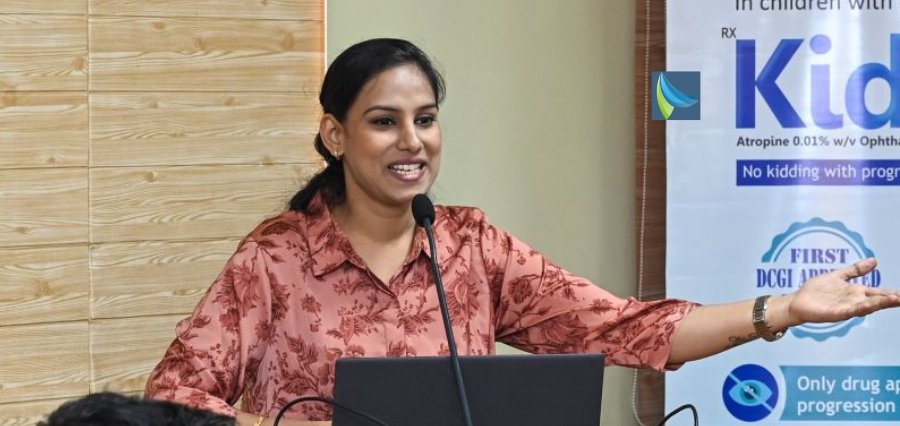
The human pair of eyes is the brain’s virtual screen through which its conscious mind comes alive into being a body and sees everything. Yet, in the ever-progressive digital times, this, one of the most essential organs, is getting damaged, and damaged early because of an increasing menace. From the very beginning of her optometry training, Dr Preeti Sharma noticed this menace – how children struggled with vision issues like myopia, strabismus, and binocular vision problems — many linked to growing digital screen exposure. “I kept asking myself: if vision is compromised so early, what does it mean for a child’s learning, confidence, and future?”
That question became her motivation. In 2011, she joined Dr Shroff’s Charity Eye Hospital (SCEH), where she found the opportunity to blend clinical practice, teaching, and research. Her involvement in Project Prakash with MIT, which studied visual development in children gaining sight after blindness, further deepened her commitment.
Since then, she has worked to integrate prevention, awareness, and training into her career — from community events like the “Myopia Run” to mentoring over 500 fellows. “For me, every child deserves to see the world clearly, and my mission has been to make that possible,” she says.
The Dual Anchor: Compassion and Excellence
Dr Preeti’s work at SCEH is guided by a philosophy that serves as her dual anchor: compassion with excellence. For her, eye care is not merely a service but a profound social responsibility. She operates on the core belief that quality healthcare should be a right, not a privilege, available to every child regardless of their economic background. This dual commitment sets SCEH apart. On one hand, the practice remains at the cutting edge of optometry and ophthalmology, integrating advanced diagnostics and evidence-based therapies. On the other hand, she ensures these world-class services are relentlessly pushed to the grassroots level, reaching children who would otherwise never receive speciality care.
This philosophy dictates every professional choice, from designing protocols for binocular vision therapy to mentoring fellows. “Compassion drives us to listen, understand, and care,” she states, while “Excellence ensures that every solution we offer stands on strong clinical and scientific foundations.” This commitment also creates a crucial multiplier effect through training; by empowering young optometrists with both knowledge and empathy, Dr Preeti ensures her mission is carried forward into countless communities.
Mastering the Digital Menace
The challenge posed by the digital age—myopia progression and digital eye strain—demands aggressive adaptation. Dr Preeti counters this threat with a three-pronged defense: continuous learning, research-driven practice, and proactive awareness. At SCEH, clinical protocols are never static. In the Myopia Clinic, this means integrating global best practices like orthokeratology and low-dose atropine therapy alongside lifestyle counseling. She maintains an active role in research and global conferences to ensure her treatments are always forward-looking.
Equally critical is the training strategy. She instils in her mentees that they are “not just treating today’s patients, you are preparing for tomorrow’s challenges.” During the pandemic, this agility allowed her programs to swiftly pivot to virtual case discussions and remote therapy models. Her third pillar involves direct public outreach through school screenings and the “Myopia Run,” actively combating the misconception that vision problems are inevitable. By embedding adaptability into the DNA of SCEH, she ensures that both her patients and her profession are prepared for the evolving challenges of the digital future.
The Partner in Learning: Mentoring the Next Wave
Dr Preeti Sharma views leadership in healthcare not as commanding, but as enabling. Having mentored over 500 fellows and students, her approach to building the next generation is founded on three core values: curiosity, confidence, and compassion. She aggressively nurtures curiosity, pushing her trainees to question the ‘why’ behind every condition, transforming every patient encounter into a unique research opportunity. Confidence is instilled through ownership; she deliberately assigns real responsibility early, allowing them to conduct assessments and design therapy protocols under close guidance. This creates a powerful sense of accountability, enabling them to handle complex cases independently.
Most importantly, she emphasizes compassion. Technical skills create a good professional, but empathy makes a great one. She constantly reminds her fellows that behind every clinical report is a child with hopes and dreams. She serves less as a traditional teacher and more as a partner in learning, fostering an environment where she also learns from their fresh perspectives. “For me, mentoring is about creating ripples,” she explains. If each trainee impacts even a hundred lives, the collective effect becomes immeasurable—the true legacy she hopes to leave behind.
The Sustainable Cure: Building a Culture of Prevention
For Dr Preeti, sustainability in healthcare means creating systems that prevent disease long before it escalates into a crisis. In pediatric optometry, this means making preventive care the ultimate form of sustainability—stopping myopia progression and detecting binocular issues early to save children from a lifetime of struggle. Her awareness programs serve as the crucial bridge between clinical science and society.
The “Myopia Run,” for instance, was a clever campaign that disguised a profound public health message within a community event: myopia is preventable, and lifestyle changes work. School screenings remain a cornerstone, taking care directly of children to uncover hidden issues where a child struggling academically might need corrective therapy. This approach ensures that when parents leave SCEH, they carry forward a culture of daily preventive counseling—covering screen time, outdoor activity, and nutrition. This continuity, she insists, is the most sustainable impact she can create for the future generation.
The Augmented Optometrist: Technology as Partner
In Dr Preeti’s department, technology is not just a tool; it is a vital partner in the fight for vision. This partnership drastically enhances accuracy and patient experience. In diagnostics, advanced imaging systems and digital platforms supplement classic tools like the synoptophore, allowing the team to detect subtle issues—from corneal changes to oculomotor dysfunctions—with objective, long-term data. This early, precise detection is crucial in the battle against myopia progression.
The biggest shift, however, is in therapy. Traditional, repetitive exercises often bore children, leading to non-compliance. She solved this by adopting gamified vision therapy software and VR-based exercises. These interactive tools boost engagement significantly, transforming tedious sessions into activities children actually enjoy, thereby improving compliance and treatment outcomes dramatically. She insists, however, that technology is only an enabler; the “warmth of communication,” the reassurance given to anxious parents, and the motivation offered to young patients “cannot be automated.” Her approach at SCEH is a powerful synergy: cutting-edge technology blended with compassionate care.
Leaders as Ripples: Fostering Growth
Dr Preeti believes that training is the most sustainable form of healthcare. She fosters growth by creating an open environment where curiosity is nurtured and no question is too ambitious. Skill development is holistic, balancing theory, hands-on practice, and research, ensuring fellows are exposed to protocol design and data analysis, not just clinical cases.
The key to empowerment is ownership. She assigns trainees to lead initiatives, whether presenting at a workshop or co-authoring research, transforming them from passive learners into active contributors. By connecting them with international experts, she ensures their perspective is global. “I aim to create leaders, not followers,” she states. The ripples of technical expertise, empathy, and innovation that her fellows carry into the world are the true measure of her legacy.
The Pandemic Pivot: Ingenuity in Crisis
The greatest test of the SCEH team’s resilience came during the COVID-19 pandemic. Pediatric eye care relies heavily on hands-on interaction and physical therapy, which lockdowns immediately stopped. Instead of paralyzing, the crisis became a catalyst for transformation.
The team rapidly reimagined care delivery remotely. They launched teleconsultations to guide parents on home-based exercises and designed simplified physical therapy kits used under virtual supervision. What started as a survival mechanism evolved into a permanent, highly accessible model for remote care. This adversity confirmed her belief that resilience is about transforming challenges into opportunities, a powerful victory born from the ingenuity and strong teamwork of a mission-driven department.
The Forge of Resilience: Adversity as Catalyst
The gravest threat to Dr Preeti’s mission came not from a new disease, but from the COVID-19 pandemic. The sudden halt of in-person treatments threatened to undo progress for children with myopia and binocular vision issues. But this adversity became a test of the team’s ingenuity. Instead of yielding, they pioneered teleconsultations, training parents virtually to become active partners in care. Customized therapy kits and engaging child-friendly digital exercises were swiftly deployed, ensuring continuity.
This period of crisis proved to be a powerful forge: children maintained their progress, families became empowered, and the institution discovered innovative remote care models. What could have been a period of regression became one of resilience and growth, introducing systems that remain integral to making care more accessible today.
The Visionary Horizon: Routine Care and Global Leadership
Dr Preeti’s gaze is now fixed on an ambitious, deeply personal future: to make early eye care as routine in India as vaccinations. Her vision is to ensure comprehensive eye screening becomes part of standard healthcare for every child, preventing developmental years from being lost to avoidable issues.
To achieve this, she aspires to scale training programs, creating fellowship hubs to decentralize expertise away from urban centers. Globally, she sees India becoming a leader in pediatric vision science, deepening collaborations like Project Prakash to share insights with the world. Technology remains central, with her ensuring that AI-assisted diagnostics and tele-optometry are adapted for cost-effective, broad community use. Her dream is simple: no child, anywhere in the world, should be held back by a vision problem that can be solved with timely and compassionate care.