
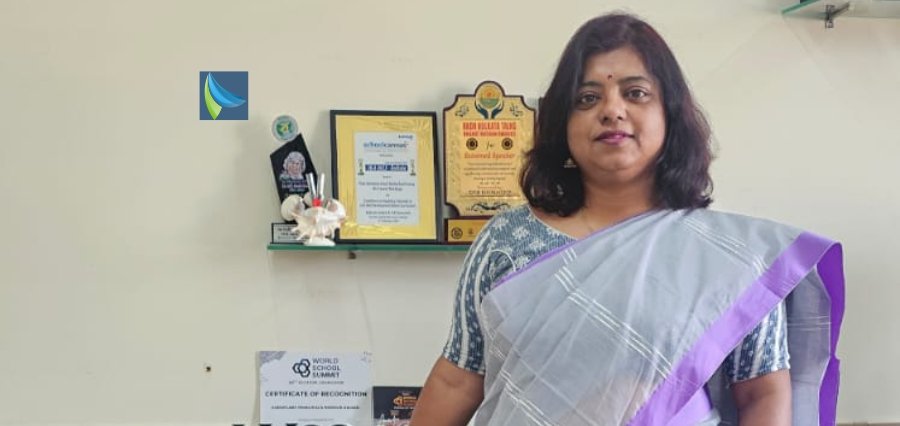
Having worked in the education field, especially in top-level management, Shabnam Bhowmick brings the knowledge and the foresight of the world of schooling. As the Principal of Podar International School, Howrah, she has a blend of academic expertise and a good understanding of operations.
She has taught CAIE IGCSE, A-level Global Perspectives, English Language and Literature and English to senior CBSE students. She has six years of experience in the field of planning, administration and working in the institutional side of education. Therefore, she is not just seeing education at the classroom level but is viewing it through the lens of a strategic leader.
Before venturing into the education sector, Shabnam had worked for almost ten years in journalism. The experience she had at that time polished her listening abilities, observational skills, and communication skills, which shaped her leadership style.
However, education was never a strategic move to leadership. It was an inner calling. This is not a tale of title-chasing, but one of gradually strolling in an upward direction to better classrooms, better teachers, children who are listened to, heard, and appreciated.
The Call to Teach: When a Chance Visit Changed Everything
Shabnam’s journey into education began unexpectedly. A simple visit to a school to help admit a friend’s child led to teaching second graders, and she fell completely in love with the classroom. That early experience awakened something deeper, i.e., the realization that education could change lives when done with care and intention.
A defining moment arrived with the introduction of Continuous and Comprehensive Evaluation (CCE). Shabnam watched a well-meaning reform struggle at the classroom level. The missing piece, she noticed, was training. Teachers were given a new system without being given the belief that they could master it. As she immersed herself in the framework, she naturally began translating it for colleagues. That was when she understood something important: leadership is not a title you seek, it is a direction you start walking.
What It Means to Be “Today’s Icon”
To Shabnam, being called an “Icon” is not about position or recognition. It is about responsibility, responsibility to influence with integrity.
“Results matter, of course. Academic outcomes reflect discipline, structure, and rigor. But culture matters more,” she adds.
She believes in schools where curiosity, collaboration, and responsibility are everyday habits, not poster slogans.
“I believe that a strong school culture shows up in how students behave, how teachers collaborate, and how every stakeholder respects shared values. It also includes a sense of duty to society, country, and Earth,” Shabnam shares.
In that sense, the title “Today’s Icon” represents a commitment to build institutions where excellence is not only achieved, but it is lived, every single day.
The Podar Philosophy: Honoring Legacy While Driving Change
Podar carries a long-standing legacy built on integrity, inclusivity, and a genuine love for learning. Shabnam sees legacy not as a weight but as a compass. Her role is not to replace these values, but to reinterpret them for a generation that learns differently.
She embraces ‘strategic disruption’, not by dismantling what works, but by asking honest questions: Are classrooms preparing children for today’s world or yesterday’s? When she looks at the National Education Policy (NEP) 2020 and the rapid integration of technology, she sees an invitation to reimagine teaching.
Her guiding principle is simple and about the same Shabnam asserts, “Keep the ‘why’ sacred and remain flexible about the ‘how’. The ‘why’, nurturing curious, compassionate, responsible human beings, never changes. The ‘how’ pedagogy, tools, and assessment, must evolve constantly.”
Navigating NEP 2020: Turning Teachers into Learning Architects
Shabnam’s most significant leadership win has been transforming teachers from knowledge-deliverers into learning-architects.
She invests deeply in sustained professional development, ongoing training focused on activity-based learning and competency-based assessment. She conducts classroom observations not as an auditor, but as a collaborator. When teachers see their Principal enter with curiosity rather than judgment, everything shifts.
Her belief is unwavering. She says, “Whether you think you can, or you think you cannot, you are right. Mindset drives mastery.”
Her job is to ensure every teacher steps into change believing they are capable. When teachers feel equipped and seen, overwhelm transforms into ownership.
Technology with a Human Heart
Shabnam often reminds her team: a screen can deliver information, but it cannot notice a child’s red eyes after a difficult morning. A platform can adjust learning pace, but it cannot sense when a high-scoring student is quietly unhappy.
Technology, used wisely, is powerful. It can personalize, accelerate, and democratize learning. But tools are only as good as the hands that use them.
“For me, the teacher–student relationship remains the beating heart of education. Everything else is infrastructure,” she adds.
Holistic Excellence: Growing the Whole Child
A grade tells you what a child answered correctly on one day. It says little about how they handle pressure, treat others, or respond to failure.
Shabnam leads with a simple philosophy: it is okay to make mistakes, just do not keep repeating the same ones. This creates psychological safety.
“When children understand that errors are information, not catastrophe, they stop performing and start learning,” she believes.
At Podar International School, Howrah, she has built structures that honor the whole child. Community outreach plays a powerful role. Students perform street plays on child safety, organize awareness drives on pollution and food wastage, and learn empathy through action. They discover that their voice matters.
The annual charity mega-event is another cornerstone. Students create and sell handmade articles, jewelry, and décor to raise funds for orphanages and NGOs. It is a masterclass in compassion, collaboration, entrepreneurial thinking, and social responsibility.
“Effort, resilience, and kindness are applauded as loudly as marks,” Shabnam asserts.
Women in Leadership: Standing Firm with Grace
Shabnam is grateful to be part of an organization where women in leadership do not have to overprove their place. Still, her journey had tests, moments when her authority was questioned or someone assumed she would be easier to intimidate. She responded with calm consistency, standing her ground until systems spoke louder than stereotypes.
Building a Culture of “We”
A school is a complex ecosystem of teachers, parents, and students. Shabnam aligns them through radical consistency, ensuring everyone experiences the same values.
With teachers, she builds trust before compliance. She advocates for them and walks into difficult conversations alongside them.
With parents, she consciously moves away from a consumer mindset toward partnership.
Transparency, involvement in community initiatives, and visible values help parents see themselves as collaborators in their child’s formation.
With students, alignment is earned through authenticity. Children quickly sense whether adults mean what they say. When they see their Principal in the community with them, values move from walls to corridors.
“A unified vision is not a document, it is a lived experience,” she says.
Mentoring the Next Principal: Leadership That Outlives You
Shabnam believes the truest measure of leadership is what continues to flourish after you leave. Mentoring future leaders is core to her purpose.
She looks for three non-negotiables:
Intellectual curiosity, a hunger to keep learning about pedagogy, human behavior, and the world students are inheriting.
Emotional courage, the willingness to hold standards, have hard conversations, and admit mistakes.
“Genuine love for children, the kind that keeps you thinking about a struggling student late at night.
Without that love, everything else is just management,” she says.
From Journalism to Education: A Storyteller Turned School Leader
Before education claimed her heart, Shabnam began her professional journey as a journalist with one of the country’s leading English dailies. For nearly a decade, she worked as a reporter listening deeply, asking difficult questions, and learning how to see beyond surface narratives.
That chapter of her life sharpened skills she still uses every day: observation, empathy, and the ability to communicate clearly under pressure. Journalism taught her to understand multiple perspectives, to verify before concluding, and to give voice to stories that might otherwise remain unheard.
When she eventually transitioned into teaching, she brought that same curiosity into the classroom. She learned to read between the lines of a child’s silence, to notice shifts in energy during lessons, and to engage parents through honest, thoughtful dialogue. Her background in storytelling also influences how she communicates vision, helping teachers and families understand not just what is changing, but why it matters.
Education may have been unplanned, but in hindsight, every earlier experience prepared her for it.
Redefining Authority Through Presence
Shabnam does not lead from behind a desk. She says, “Authority is built through presence, being visible in classrooms, accessible to parents, and available to teachers during moments that matter.”
Students see her during community programs. Teachers experience her as a collaborator rather than a supervisor. Parents encounter her as a listener who explains decisions with clarity and care.
This presence creates trust. It also sets a tone for the entire institution. When the Principal models calm during conflict, curiosity during change, and consistency during pressure, others follow. Over time, this becomes part of the school’s identity.
She often says that, “Leadership is not about control, it is about creating conditions where people can do their best work.”
Holding Space for Teachers: The Quiet Backbone of Every School
While students are at the heart of education, Shabnam knows that teachers are its backbone. Her leadership places strong emphasis on teachers’ wellbeing, professional dignity, and emotional support.
She understands that educators carry invisible burdens, including lesson planning after hours, concern for struggling students, and the constant pressure to meet expectations from every direction. Rather than focusing only on outcomes, she makes space for conversations about fatigue, motivation, and growth.
Her approach is simple: when teachers feel respected and supported, they teach better. When they feel seen, they stay resilient. And when they are trusted, they innovate.
“By creating an environment where feedback flows both ways, I ensure that improvement is continuous and collaborative, not imposed,” she shares.
Leadership at Home: The Personal Side of Strength
Behind the professional role is a deeply personal journey. With her husband serving in the Army, Shabnam shoulders the responsibility of raising two children largely on her own. Some days, school needs more of her than she feels she has left. Some evenings, her children need more than a tired Principal can give. She has learned to hold this tension with grace, being fully present wherever she is, without guilt for what she is not doing simultaneously.
She speaks openly about the tension between professional demands and parental presence. There are evenings when school decisions spill into family time, and mornings when personal worries must be set aside to lead with clarity.
Over time, she has learned to accept imperfection, to give her best where she is, without carrying guilt for where she cannot be at that moment. Her children have grown up watching strength in action, learning that strength does not mean never struggling, it means showing up anyway.
Resilience After the Pandemic: Rebuilding Community First
The pandemic created learning gaps, but also made trust gaps and safety gaps. Shabnam’s first strategy was to rebuild the community before the curriculum. Outreach initiatives brought back social confidence. When children work together for meaningful causes, self-worth returns.
Her second strategy focused on teacher wellbeing. Resilient institutions are built by resilient people, and resilient people need to feel seen.
The third was structural: competency-based, activity-led pedagogy that meets students where they are, building from strength rather than papering over loss.
“Resilience, for me, is not bouncing back. It is bouncing forward, wiser and more human,” she says.
Parents as Partners
Shabnam understands that the consumer mindset often comes from anxiety about a child’s future. She begins by understanding that anxiety, but does not yield to every demand. The child’s best interest is not always the parent’s comfort in the moment.
When parents see decisions rooted in care rather than bureaucracy, partnership grows. Community events make growth visible, such as students performing self-written plays or showcasing creations. Visibility answers the deepest parental question: Is my child truly growing here?
Personal Equilibrium: Restoring the Self
Balance, Shabnam says, is not a destination, it is a daily practice.
She is a voracious reader, finding sanctuary in books that challenge and restore her. She and her son exchange book reviews. With her daughter, she enjoys DIY projects, creating with her hands after long cerebral days. The three of them travel together whenever possible, discovering new places and renewing perspective.
As a single parent, she is intentional about presence. She cannot always control how many hours school needs, but she can control the quality of attention she gives her children and herself.
She does not believe in the myth of the leader who never falters. She believes in the leader who knows how to restore.
The 2030 Vision: Teaching Empathy
If Shabnam could give every child one trait, it would be empathy, the active kind. Not sympathy, but the ability to feel with another person.
She believes tomorrow’s world will be complex, technologically, environmentally, and politically. The students who will navigate it with grace are those who can listen deeply and ask: What does this mean for you?
Community programs already teach this. When a child performs a street play about safety or food wastage, they practice radical empathy. They learn that other lives matter. If that is what students carry forward from Podar International School, Howrah, Shabnam says her work will be done.
Roots That Built Resilience
Two experiences shaped Shabnam’s strength. She grew up in the Andaman Islands, where life in remote regions taught resilience and a never-give-up spirit.
She began her career as a journalist with a leading English daily, spending nearly a decade as a reporter before transitioning into teaching. That early training sharpened her listening, observation, and storytelling skills, which she now brings to school leadership.
A Leader Who Builds People Before Institutions
Shabnam Bhowmick leads with intellect, empathy, and unwavering standards. She builds schools where teachers feel capable, children feel safe, and parents feel included. Her leadership proves that education is not only about outcomes, it is about relationships.
And in a world that needs both excellence and humanity, that may be her most iconic legacy.