
As organizations navigate an increasingly complex and collaborative work environment, traditional leadership models centered on hierarchy and authority are undergoing a fundamental shift. Dr. Vishwanand Pattar presents an alternative framework which is Companion Leadership, which emphasizes connection, trust, and shared purpose as the foundation of effective leadership.
For decades, leadership approaches have largely positioned leaders either at the forefront, directing strategy, or behind teams, driving performance through pressure. However, the rise of knowledge workers, creative professionals, and collaborative teams has redefined expectations. In this evolving landscape, leadership is no longer defined by control, but by the ability to build meaningful relationships and enable collective success.
The Lantern Bearer: A New Leadership Paradigm
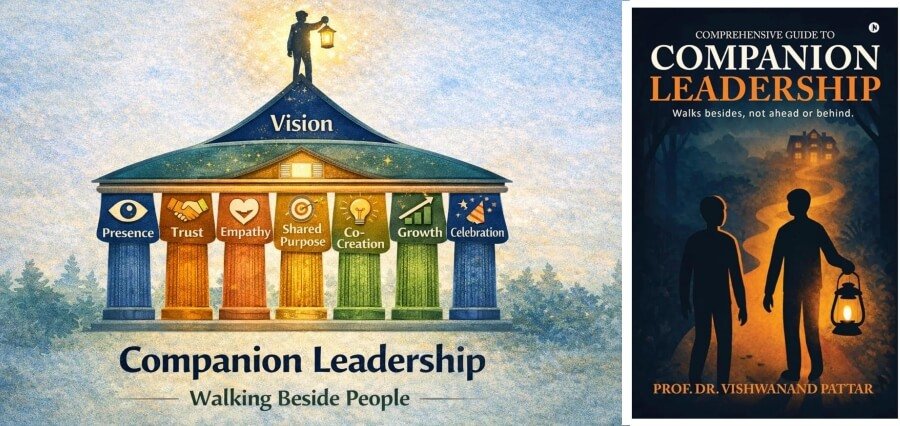
At the core of Companion Leadership is the principle that leaders should “walk beside” their teams. Dr. Pattar illustrates this concept through the metaphor of the Lantern Bearer.
In this model, a leader carrying a lantern is walking alongside the group rather than ahead or behind. The lantern does not dictate direction but provides clarity and safety, allowing individuals to navigate their own paths with confidence. This approach repositions the leader as a partner in a shared journey rather than a distant authority figure.
The Seven Pillars of Companion Leadership
Companion Leadership is structured around seven foundational principles that foster trust and collaboration within organizations:
- Presence: Leaders remain visible, accessible, and actively engaged, demonstrating attentiveness to the day-to-day realities of their teams.
- Trust: Built through transparency and consistency, trust establishes psychological safety within the organization.
- Empathy: Understanding the human dimension of performance enables leaders to support both professional and personal well-being.
- Shared Purpose: Aligning individual motivations with organizational goals enhances clarity and engagement.
- Co-Creation: Collaborative problem-solving encourages innovation through collective intelligence rather than hierarchical decision-making.
- Growth: Leaders act as mentors by providing guidance and opportunities that support individual development.
- Celebration: Recognizing progress and collective achievements strengthens motivation and reinforces a sense of belonging.
The “House of Companionship” Framework
Dr. Pattar further conceptualizes the ideal workplace as a “House of Companionship,” a living framework that integrates cultural and structural elements of leadership.
In this model, trust and shared meaning form the foundation. Presence and empathy serve as the pillars that support the structure, while values and clearly defined boundaries act as protective walls. Within this environment, dedicated spaces for joy, reflection, growth, and healing contribute to both emotional and intellectual development.
The roof represents a shared vision that unites the organization, while windows symbolize transparency, ensuring that trust remains visible and sustained.
A Shift Toward Relationship-Driven Leadership
Companion Leadership underscores a broader shift in leadership philosophy. As organizations adapt to rapid change and uncertainty, traditional command-driven models are increasingly insufficient. Sustainable success now depends on leaders who prioritize connection, enable autonomy, and cultivate environments where individuals feel supported and empowered.
A Call to Action
Dr. Pattar emphasizes that leadership is not defined by authority, but by relationships. By choosing to lead alongside their teams, leaders can create spaces where individuals feel confident to take risks, contribute ideas, and collaborate toward shared goals.
In an era shaped by transformation, Companion Leadership presents a framework for building trust-driven, resilient, and purpose-led organizations.
Disclaimer –
This article is a work of original content created for public relations and informational purposes only. It may be published across multiple digital platforms with the full knowledge and consent of the author/publisher. All images, logos, and referenced names are the property of their respective owners and used here solely for illustrative or informational purposes. Unauthorized reproduction, distribution, or modification of this article without prior written permission from the original publisher is strictly prohibited. Any resemblance to other content is purely coincidental or used under fair use policy with proper attribution.