
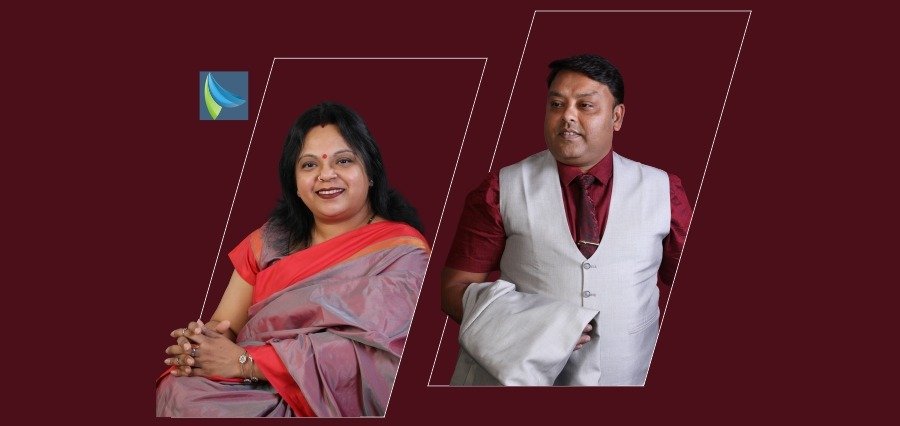
The development of Tutelage as an educational system began to take shape when the first components of its system began to function in schools and educational facilities, where people used to study numerous subjects and to interact with students who needed help with understanding how to apply theoretical knowledge. The academic and professional backgrounds of Dr. Ashok Vankadari and Dr. Chandrakala Ashok created their shared operational problem which involved students who possessed knowledge but did not know how to use it.
The process of developing a common goal started with the initial act of observing the situation. They established an educational ecosystem that combined practical world applications with learning opportunities to deal with the existing problem. Dr. Ashok, as Founder and Chairman and MD, establishes institutional vision through his strategic foresight, while Dr. Chandrakala, as Co-Founder and Director of Tutelage, maintains operational excellence with academic discipline.
Together, their journey reflects a rare synergy, one defined not just by leadership but by a commitment to reshaping education into a tool for life, not just learning.
A Shared Vision Born From Purpose
The entrepreneurial journey of Dr. Chandrakala and Dr. Ashok traces its roots to a profound observation they both made independently throughout their extensive careers in academic and professional development. Both leaders emerged from rigorous academic backgrounds and spent years engaging directly with students, educational institutions, and evolving learning frameworks. Yet, across these diverse interactions, they consistently encountered the same paradox: students accumulated theoretical knowledge with remarkable precision but struggled to apply that knowledge in solving real problems.
“A defining moment in our journey arrived when we recognized that traditional education often focuses heavily on theoretical knowledge, while students struggle with practical application, critical thinking, and career readiness,” explains the co-founding team. Through their interactions with learners and educators, they consistently observed a disconnect between academic learning and real-world expectations. This realization became the turning point that inspired them to move beyond conventional roles and create a solution-driven platform.
What distinguishes the Tutelage story from countless other educational ventures lies not merely in identifying a problem, but the partnership of the team itself demonstrates complementary strengths that have enabled them to transform insight into action. Together, they established Tutelage with a guiding philosophy: “Knowledge for Life”, a principle that echoes through every initiative, every program, and every interaction the organization undertakes. Their collaboration represents something increasingly rare in the education sector: two leaders whose individual visions align so completely that they strengthen rather than complicate each other’s work.
Leadership Architecture: Strategy Meets Execution
The internal architecture of Tutelage’s leadership reveals a carefully calibrated division of responsibilities that paradoxically creates unified vision. Dr. Ashok, in his capacity as Founder and Chairman, concentrates his focus on long-term strategic positioning, market trends, and institutional partnerships. He orchestrates the organization’s paradigms and cans the horizon for emerging educational paradigms and ensures that Tutelage remains anchored to its core mission even as external circumstances shift. His advantage emphasizes the “where” and “why” of organizational growth.
Complementing this strategic perspective, Dr. Chandrakala is serving as Co-Founder and Director, breathes operational life into the organization’s vision. She is overseeing program design, implementation mechanisms, and quality assurance, ensuring that every initiative maintains rigorous academic standards while remaining responsive to institutional and student needs. Her domain encompasses the “how” and “when” of execution, translating strategy into scalable, sustainable programs.
Rather than creating silos, the dynamic duo fosters constant dialogue and mutual validation. Strategic ambitions face the sobering reality of operational constraints and implementation challenges. Simultaneously, operational excellence gains clarity from strategic context. Both leaders maintain what they describe as “constant collaboration, open communication, and shared values”, conditions that create alignment across all organizational levels while preventing the rigidity that often accompanies hierarchical structures.
The result manifests as a culture distinctly different from many educational organizations. Rather than top-down mandates, Tutelage operates through what both leaders call “a culture of innovation, accountability, and student-centric thinking.” This cultural foundation enables the organization to operate with a unified vision while simultaneously adapting to evolving educational needs—a balance most institutions struggle to achieve.
Leadership Philosophy Rooted in Evolution
Both Dr. Ashok and Dr. Chandrakala embrace a leadership philosophy that treats “future-readiness” not as a destination but as a continuous process. They recognize that education exists in a relationship with the society it serves, meaning that when society accelerates, education must accelerate proportionally. “Being future-ready transcends technology adoption; it encompasses cultivating adaptability, fostering critical thinking, and nurturing an institutional mindset of perpetual learning,” says Dr. Chandrakala.
Central to their approach stands what they term “purpose-driven leadership.” Rather than viewing themselves purely as administrators managing systems, they position themselves as enablers of transformation. “We actively work to create ecosystems where students, educators, and institutions simultaneously thrive, recognizing that educational progress rarely occurs in isolation,” says Dr. Ashok. This philosophical stance demands that they move beyond rigid institutional frameworks, instead of embracing the principles of innovation, collaboration, and real-world relevance in every program they design and service they deliver.
Equally fundamental to their approach runs a deep people-centric orientation. Whether engaging with team members, institutional partners, or learners themselves, both leaders prioritize trust, inclusivity, and mutual growth. They encourage organizational cultures where ideas circulate freely regardless of hierarchical position, where experimentation receives active encouragement, and where learning becomes institutionalized rather than episodic. This human-centered focus permeates decision-making and shapes how they engage with stakeholders.
Core Values as Navigational Compass
The decision-making framework that guides Tutelage’s operations rests upon a carefully considered set of core values. Both Dr. Ashok and Dr. Chandrakala begin with impact-driven thinking where every initiative undergoes evaluation based on the concrete value it creates for students, institutions, and the broader academic ecosystem. In their view, innovation serves no purpose if it fails to enhance learning outcomes or address genuine gaps within educational systems. This focus prevents the organization from pursuing trendy initiatives disconnected from real educational needs.
Integrity and quality represent non-negotiable principles. Both leaders understand that operating within education, a field that shapes human potential and societal futures demands unwavering commitment to credibility, academic rigor, and ethical practices. This principle ensures that even as Tutelage scales or experiments with innovative approaches, the organization maintains consistency in delivering reliable, high-quality solutions. There exists no acceptable trade-off between growth and quality; they consider such trade-offs a false dichotomy.
The leaders practice what they call “balanced innovation”, an approach that embraces new technologies and methodologies while maintaining measured implementation strategies. Rather than adopting innovations wholesale, the company tests new approaches, refines them based on feedback, and validates their effectiveness before large-scale deployment. This methodology permits forward-thinking evolution without sacrificing operational stability or strategic direction. The organization effectively operates between the paralysis of excessive caution and the recklessness of unchecked experimentation.
Finally, collaboration and adaptability occupy central positions in their approach. Both recognize that superior solutions emerge through listening, to students, educators, industry professionals, and all stakeholders and evolving accordingly. This commitment keeps Tutelage responsive within constantly shifting environments.
Maintaining Relevance in a Global Context
In contemporary contexts where education and enterprise increasingly intertwine, Tutelage has developed sophisticated mechanisms for maintaining alignment with global trends while honoring local contexts. Dr. Ashok and Dr. Chandrakala ensure this relevance through deliberate cultivation of what they term the “industry-academia interface.” “By maintaining active engagement with industry professionals, educational institutions, and subject-matter experts, we stay constantly informed about emerging skill demands, technological transformations, and international best practices. This intelligence enables the organization to design solutions that operate simultaneously on academic rigor and professional relevance,” says Dr. Chandrakala.
Research and benchmarking constitute additional pillars of their strategy. The organization closely monitors global educational evolution, whether involving technology integration, interdisciplinary learning approaches, or outcome-based educational models, then thoughtfully contextualizes these insights for their specific operating environments. Rather than transplanting global models wholesale, both leaders insist on adaptation processes that generate authentic value for their communities. This approach acknowledges the reality that effective educational solutions require both global awareness and local wisdom.
Program design at Tutelage deliberately avoids static frameworks. Instead, all initiatives evolve continuously based on performance feedback, implementation insights, and changing requirements. This organizational agility ensures that offerings remain perpetually current and demonstrably effective. The organization also emphasizes skill-centric and application-oriented learning approaches, embedding practical exposure, problem-solving opportunities, and real-world scenarios directly into program structures. By doing so, learners develop capabilities meeting both local and global professional expectations.
Strong feedback loops complete their relevance machinery. Continuous input from students, educators, and institutional partners flows directly into program refinement processes. This systematic approach to gathering and implementing stakeholder feedback keeps Tutelage’s offerings aligned with actual needs rather than hypothesized ones. Through this integrated approach, the organization maintains simultaneous alignment with global trends and deep relevance to the communities it serves.
From Challenge to Opportunity: A Case Study in Transformational Leadership
Tutelage’s most instructive success emerged not from an absence of obstacles but from skillful transformation of significant challenges. One major strategic hurdle the organization faced involved convincing established educational institutions to transition from traditional academic frameworks toward more application-oriented, industry-relevant learning models. While institutions intellectually acknowledged the importance of such innovation, actual implementation hesitation arose from legitimate concerns: feasibility questions, scalability challenges, and uncertainty regarding outcomes.
Rather than aggressive advocacy for wholesale transformation, both Dr. Ashok and Dr. Chandrakala deployed a phased implementation strategy grounded in patience and collaboration. They initiated small, carefully structured pilot programs that demonstrated clear value without disrupting existing institutional systems. These carefully designed experiments created proof-of-concept evidence while enabling risk-mitigation for their institutional partners. Critically, the leaders involved institutions, faculty, and students as co-creators throughout the process, ensuring stakeholders felt invested rather than imposed upon.
“Continuous feedback loops and measurable outcome documentation from these pilot initiatives gradually built institutional confidence and trust,” says Dr. Ashok. As tangible results emerged, improved student engagement metrics, enhanced practical understanding, and positive institutional feedback, the initial resistance transformed into genuine enthusiasm. What could have remained a lasting barrier instead became an opportunity to refine approaches, deepen partnerships, and establish scalable innovative models.
This experience crystallized an important leadership principle both embrace transformation proves most effective when inclusive, incremental, and impact-demonstrating. The organization’s expansion and positioning as a trusted partner in educational transformation resulted directly from this approach. Rather than viewing resistance as defeat, both leaders reframed it as feedback and opportunity for program refinement. This mindset transformation, treating obstacles as valuable information rather than blockers, defines their leadership approach throughout Tutelage’s operations.
Building Cultures That Multiply Innovation
Creating organizational cultures where collaboration, innovation, and continuous learning flourish demands conscious architectural design. Both Dr. Ashok and Dr. Chandrakala have deliberately constructed Tutelage’s internal environment to nurture these qualities. They prioritize open communication and shared ownership throughout the organization. Within Tutelage, ideas receive encouragement across all hierarchical levels, and team members gain autonomy for experimentation and initiative-taking. This approach simultaneously builds individual confidence and cultivates collective responsibility for outcomes.
Innovation flourishes through what both leaders describe as “learning by doing.” Rather than insisting on flawlessness before implementation, Tutelage encourages teams to explore approaches, pilot ideas in real contexts, and refine based on actual feedback. This creates psychological safety for experimentation, where learning from failures registers as progressive rather than regressive. Such environments produce more innovation than risk-averse alternatives because they transform fear of failure from a paralyzing force into a learning mechanism.
Both leaders actively invest in continuous learning and skill development for their teams. Regular knowledge-sharing sessions, exposure to emerging industry trends, and structured engagement with academic and professional experts keep Tutelage’s workforce perpetually updated and future-ready. This investment signals organizational commitment to people as appreciating assets rather than fixed resources.
Collaboration extends beyond organizational boundaries. Both leaders actively involve institutional partners, educators, and students in designing and evolving initiatives, making processes inclusive and aligned with genuine needs. This co-creation approach strengthens trust while ensuring solutions operate with both practical viability and meaningful impact. Ultimately, their efforts construct what both describe as a “growth-oriented ecosystem” where curiosity receives encouragement, adaptability gains valuation, and every stakeholder recognizes themselves as contributor to Tutelage’s larger vision of transforming education.
Empowering Tomorrow’s Leaders and Innovators
As leaders themselves, Dr. Ashok and Dr. Chandrakala recognize empowerment extends far beyond knowledge transmission. True empowerment involves building confidence, fostering adaptability, and cultivating strong senses of purpose in emerging generations. This philosophy profoundly shapes how Tutelage designs its learning experiences.
The organization deliberately bridges knowledge with application. Rather than isolating theory into classrooms, Tutelage embeds real-world projects, case-based learning approaches, and structured industry interaction directly into learning experiences. This methodology helps students and young professionals develop practical problem-solving abilities alongside theoretical understanding, preparing them for actual professional environments they will inhabit.
Equally important to Tutelage’s approach involves fostering entrepreneurial mindsets. Both leaders encourage individuals to think independently, embrace initiative, and reframe challenges as opportunities. Whether learners subsequently pursue educational, entrepreneurial, or professional paths, this foundational mindset enables navigation of uncertainty with resilience and creative problem-solving. “Mentorship occupies central importance in their empowerment strategy. By providing continuous support, constructive feedback, and exposure to experienced professionals, we ensure learners make informed decisions and develop clarity regarding career trajectories,” says Dr. Chandrakala. This personalized approach produces not merely skilled individuals, but self-aware, goal-directed professionals.
Both also emphasize adaptability and lifelong learning as foundational capacities. In rapidly evolving professional contexts, the ability to learn, unlearn, and relearn operates as a competitive advantage. By instilling curiosity, developing critical thinking capabilities, and promoting openness to new ideas, Tutelage prepares learners for perpetual evolution. The ultimate goal transcends preparing individuals for contemporary opportunities; it aims to equip them to shape future possibilities themselves, developing confident, capable professionals ready to thrive in emerging environments and drive their own transformations.
Adaptability as Competitive Architecture
Adaptability occupies not peripheral but central position in Dr. Ashok and Dr. Chandrakala leadership paradigm. They view it as foundational to remaining relevant, resilient, and forward-oriented within environments defined by perpetual transformation. Rather than treating adaptability as reactive response to disruption, both leaders approach it as proactive mindset, staying curious, continuously monitoring environmental signals for emerging trends, and maintaining openness to reconsidering established approaches.
In navigating disruptions, their adaptability manifests as calm decisiveness. Instead of resisting change, both leaders concentrate on reframing challenges as opportunities, quickly assessing what requires evolution, what warrants retention, and how progress can accelerate. This balance between agility and stability enables responsive action without losing strategic direction. Regarding technology adoption, both practice what they term “thoughtful adoption.” They embrace innovation, but with clarity about relevance, scalability, and impact on actual learning outcomes. By systematically piloting, testing, and refining approaches, Tutelage ensures technology enhances rather than complicates educational experiences.
Both leaders recognize that organizational adaptability requires embedding flexibility at all levels. By encouraging team flexibility, promoting continuous learning, and fostering openness toward change throughout Tutelage, they create ecosystems where evolution feels natural rather than disruptive. Ultimately, their adaptability leadership balances groundedness in core purpose with flexibility in approaches, enabling navigation of uncertainty and strategic leverage of change to generate meaningful, lasting impact.
Vision for the Future: Creating Irreversible Impact
The long-term vision driving Dr. Ashok and Dr. Chandrakala extends beyond organizational growth toward something more ambitious: evolving Tutelage into a globally recognized academic ecosystem that seamlessly integrates education with enterprise. They aspire to create platforms where learning transcends classroom boundaries and remain continuously shaped by real-world relevance, innovation, and international collaboration.
Central to this vision lies redefining how education prepares individuals for life and professional engagement. Both leaders aim to develop scalable, future-ready models integrating academic depth with practical exposure, ensuring learners possess not merely knowledge but the skills, mindsets, and adaptive capacities required to thrive globally. Building strong international partnerships constitutes another critical dimension, collaborating with institutions, industry leaders, and educators to co-create solutions that achieve simultaneous local relevance and global alignment.
Both leaders recognize that lasting impact requires empowering educators and institutions. By providing innovative tools, practical frameworks, and comprehensive training, “Tutelage aims to elevate overall educational delivery quality and enable sustainable transformation at scale. Rather than becoming mere consultants, they position themselves as partners in institutional evolution,” says Dr. Ashok.
Ultimately, Dr. Ashok Vankadari and Dr. Chandrakala Ashok seek to catalyze what they describe as an “irreversible shift in perspective,” where education becomes consistently understood as dynamic, application-oriented, and fundamentally connected to real-world outcomes. Should they succeed in establishing this standard, ensuring that future generations enter professional and personal worlds better prepared, more confident, and globally competent, they believe that achievement will constitute their most meaningful and enduring contribution. In pursuing this vision, both leaders demonstrate that effective educational transformation requires not merely ideas, but persistent commitment, collaborative partnership, and leadership grounded in genuine purpose. Tutelage, under their guidance, embodies a compelling model for how visionary leaders can reshape educational possibilities.