
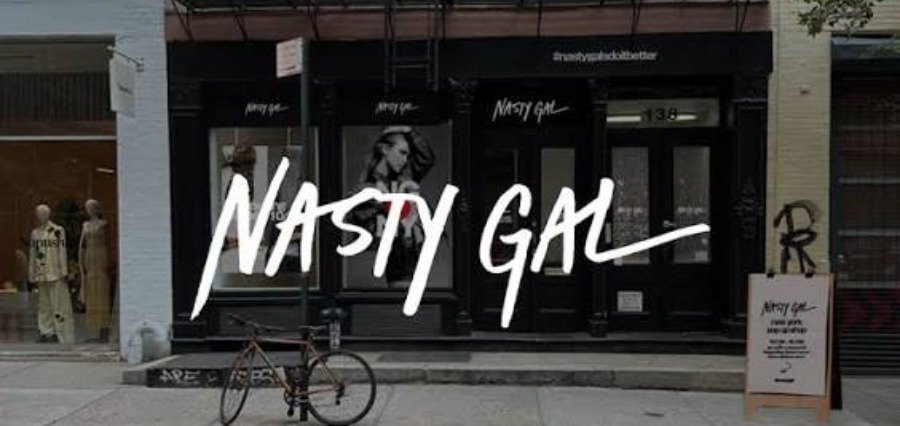
Nasty Gal: A Fashion Brand Built on Digital Power
Nasty Gal is one of the most talked-about fashion brands of the digital era because it changed the way young consumers discovered, connected with, and bought from online labels. Long before direct-to-consumer fashion became the norm and before every brand learned how to build a personality on social media, Nasty Gal had already created a model that felt modern, personal, and highly recognisable. It was not built through celebrity endorsements, traditional advertising, or a large retail network. It was built through a sharp point of view, a founder who understood online culture, and a brand voice that spoke directly to a generation of women looking for confidence, individuality, and style that felt different from mainstream fashion.
However, the significance of Nasty Gal in retail history lies not only in the speed of its rise, but also in its ability to prove that digital identity may become a serious competitive advantage. Founded by Sophia Amoruso with an online resale of select vintage items, Nasty Gal became a fashion brand earning over $100 million annually. At the same time, it demonstrated the possibility of building a strong brand through storytelling and visual identity as well as good customer relations. Nasty Gal was not just a clothes retailer. It sold attitude, aspiration, and a sense of belonging to a fashion community that felt bold, independent, and culturally aware.
The brand also arrived at exactly the right time. It appealed to an audience that spent increasing amounts of time in the virtual space, spotting trends through social media sites, and reacting to brands that were more human than companylike. Nasty Gal recognized this trend early on and made the most of it. Nasty Gal’s success story can be explained in the context of fashion retail changing to the point where taste, timing, and digital footprint mattered just as much as store presence and advertising budgets. This is why Nasty Gal is such an interesting case study in business. It is an excellent illustration of how successful fashion brands may emerge based on instinct and community.
Vintage Reseller Turns into Fashion Brand
The success of Nasty Gal Vintage can be attributed to the way in which the products were marketed online. Rather than using the traditional way of marketing their products, whereby the features of the products are simply highlighted, Amoruso decided to market the products in a unique way. This is an indication of the confidence of Amoruso and the uniqueness of her customers.
Nasty Gal Vintage did not depend on the use of eBay anymore by the year 2008. This indicates that Amoruso had now taken control of how her customers perceived her products. It was also at this point that her company had developed. She had managed to grow her company sufficiently such that by 2011, she could call herself a million dollar fashion company.
The second move that Nasty Gal took in 2008 consisted in opening its own website. Thus, Amoruso ensured herself having the full control over the experience of her clients and made one more move forward to the development of her company. By 2011, Amoruso’s business had already become famous brand in the million dollar fashion world.
Brand Development Without the Traditional Marketing Investment
That what is special in the case of Nasty Gal is the fact that the brand reached success during its initial period of time by not using any traditional marketing techniques at all. During its initial period of time, the company did not use any print media, television advertisements, or any other type of advertisement. The growth of Nasty Gal was achieved due to the ability of Amoruso to establish a connection with the clients, due to the particular visual identity of the company, and due to the unique tone of voice.
At first, Amoruso used Myspace to communicate with her future clients and to attract them to her eBay shop. Then, Amoruso started to expand her business by means of using Tumblr, Facebook, and Instagram.
The story of Amoruso herself was part of the brand’s story. She had started the company with no experience in the fashion industry and without any financial or professional support in the very early stages, which appealed greatly to girls who were into creative and independent work. Sophia Amoruso shared her journey from online vintage seller to fashion entrepreneur in her 2014 memoir #GIRLBOSS. The book became a New York Times bestseller and later inspired a Netflix series in 2017.
Scaling the Business
As revenue expanded, outside investment followed. In 2012, Nasty Gal raised its first institutional funding from Index Ventures. Later funding rounds also saw participation from Thrive Capital and Hercules Capital. Total funding is commonly estimated in the $40 million to $65 million range, depending on the source.
The company used that capital to grow its owned collections, expand into categories such as swimwear, lingerie, and accessories, strengthen its team, and build a broader retail presence. Nasty Gal also entered physical retail, opening on Melrose Avenue in Los Angeles in late 2014 and later on Santa Monica’s Third Street Promenade in 2015. These steps reflected the ambition to evolve from a digital cult favourite into a broader fashion business with multiple channels and a larger product universe.
In January 2015, Amoruso stepped down as CEO, and Sheree Waterson, who had served as company president, took over the role. Amoruso remained involved as founder and executive chairwoman, while the company continued to navigate a new phase of growth and organisational development.
A Time of Transition for Nasty Gal
At the time of 2016, Nasty Gal had started its journey towards transition as the company adjusted to the changes needed for its growing scale. The company had grown very fast, from being a small entrepreneur company to becoming a more developed retail company. That shift required a different level of operational structure, and it became a pivotal moment in the brand’s story.
In November 2016, Nasty Gal filed for Chapter 11 bankruptcy. While the filing marked the end of its first chapter, it also highlighted something important about modern retail: building a beloved brand and building the systems to support that brand at scale are two very different challenges. Nasty Gal had already proven the strength of its creative vision, customer appeal, and digital presence. The next phase required a different operating model.
The Boohoo Acquisition and a New Chapter
In February 2017, Boohoo Group acquired Nasty Gal’s intellectual property and customer database. The specific purchase price differs from one source to another, with estimates ranging from $20 million to $40 million among other figures. However, the essence is clear – Nasty Gal still had significant brand equity, recognizable branding, and customers who deserved investment.
Boohoo, therefore, could not fail to see the value that existed. Nasty Gal had brand equity and distinct branding with a devoted customer base. Using the existing logistics and technology systems of Boohoo, the label had the chance of surviving on a platform capable of scaling up internationally.
Nasty Gal Under Boohoo
Under Boohoo, Nasty Gal took on a new structure while retaining the attitude and aesthetic that made it recognisable. The brand now operates with shared technology, warehousing, and supply chain support across Boohoo’s portfolio. Its product range has expanded significantly, and its pricing sits firmly within the fast-fashion category.
In November 2017, Nasty Gal opened a pop-up on Carnaby Street in London, signalling Boohoo’s efforts to expand the label’s reach internationally. The business today is different from the founder-led version Amoruso built, but the brand still carries the bold, expressive identity that first attracted its audience.
What the Story Teaches
Nasty Gal’s story offers two important lessons.
The first is about brand building. Nasty Gal proved that a compelling voice, visual language, and true understanding of one’s audience can lead to amazing success without big marketing budgets or help from the existing industry establishment. moruso spoke to customers as people rather than as a target segment, and that helped build a level of loyalty many larger brands spend years trying to create.
The second is about scale. As a company grows, creative vision needs to be matched by systems, structure, and long-term operational planning. Nasty Gal’s rise showed the power of getting the brand right from the beginning. Its next phase showed how important it is to build the business foundation alongside that momentum.
Taken together, the Nasty Gal story is not just about fashion or e-commerce. It is about what happens when cultural instinct, digital storytelling, and entrepreneurial energy come together at exactly the right moment. That is why the brand continues to be studied, referenced, and remembered.