
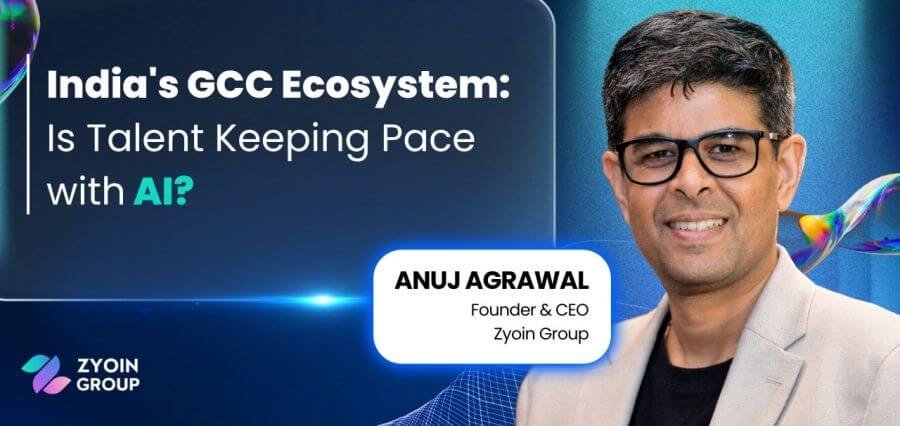
For nearly twenty years, India’s Global Capability Centers have followed a script everyone in the industry could recite by heart. Set up a center, staff it up, expand the mandate, and watch it graduate from a back-office support arm into something the global parent company genuinely leans on. The climb was steady and, for the most part, predictable.
That script is being rewritten. Spend time with anyone leading talent or technology functions inside a GCC today, and a new undertone comes through almost immediately. AI agents are no longer a side tool bolted onto existing workflows to make them faster. They are beginning to own pieces of the work outright. Which means the question keeping leadership up at night has shifted, too. Nobody is asking how many roles GCCs will add this year anymore. They want to know what those roles will look like six months from now, and whether India has enough people ready to fill them.
The Career Ladder is Losing Its Rungs
Considering the career path most engineers were raised on: put in the time, earn the promotion, repeat. That formula is losing its grip. As AI takes over the repetitive, rule-bound slices of knowledge work, tenure stops being the trump card it once was; adaptability is. The squeeze is being felt hardest by the people sitting in the middle of the org chart, those whose careers were built on dependable execution rather than judgment calls, client relationships, or strategic thinking.
Experience hasn’t lost its value, but it no longer buys automatic relevance. “The professionals who will thrive in the AI era are those who treat AI as a collaborator rather than a threat, and who keep reinventing their skills instead of coasting on whatever got them their last promotion,” says Anuj Agrawal, Founder & CEO of Zyoin Group.
For someone early in their career, that’s a bigger shift than it first appears. Progress stops being a fixed staircase; you climb one rung at a time. It becomes a matter of how many judgment-heavy, cross-functional capabilities you can accumulate, precisely the kind of work AI still finds difficult to replicate.
A Winner-Take-Most Market Is Taking Shape
There’s a second, quieter shift happening underneath all of this: talent is starting to concentrate at the very top of the pyramid. As GCCs get serious about building AI capability, appetite for broad, generalist tech hiring is cooling, while a narrow band of specialists, people who can architect agentic systems, run MLOps at scale, or do genuine applied AI engineering, are commanding fast-rising pay. It’s starting to resemble a winner-take-most market, with conventional tech roles squeezed from both sides: automation eating into demand from one end, specialisation pulling talent and compensation toward the other.
“We’re moving from a hiring model built on headcount to one built on impact density,” Agrawal points out. “Organisations don’t need a hundred generalists anymore. They need ten people who can do what a hundred used to, with AI doing the rest. That doesn’t just change recruiting, it changes how companies plan their entire talent strategy.”
Is Confidence Actually Backed by Readiness?
Which raises the harder, less comfortable question: is India’s GCC ecosystem actually as prepared for this shift as the prevailing optimism suggests, or is that confidence a holdover from a different era? Much of it rests on the scale and cost advantages India has built over two decades, and neither of those automatically converts into AI readiness. If skilling doesn’t catch up quickly enough, the risk isn’t just slower growth. It’s a gradual erosion in delivery quality, and over time, in how much global clients are willing to trust India to get the work done.
Closing that gap will likely take movement on several fronts simultaneously. Education needs to move beyond textbook computer science toward something closer to applied AI literacy. Hiring practices need to start rewarding how frequently someone reskills, not just the degree they earned years ago. And the broader skilling ecosystem needs to treat AI fluency as a baseline expectation for everyone, not a specialization reserved for a select few.
GCCs and Startups Are Competing for the Same Talent
Then there’s the quiet tug-of-war playing out between GCCs and startups for the same pool of AI talent. Right now, GCCs hold the advantage, offering scale, stability, and access to genuinely global problems, and that combination is pulling strong talent away from younger companies.
There’s a real risk that startups end up functioning as little more than training grounds, developing people only to lose them to larger centers down the line. But Agrawal sees room for a healthier version of this dynamic. “The healthiest version of this ecosystem isn’t a one-way flow. It’s a real exchange. GCCs give people scale and structure; startups give them risk and reinvention. How much of India’s talent advantage holds up will depend on how freely that exchange happens in both directions,” he says.
The Real Test Ahead
That, perhaps, is the real test ahead for India’s GCC story. Not whether the centers keep growing, that part seems all but certain, but whether the confidence driving that growth is finally matched by the readiness it has long assumed.