
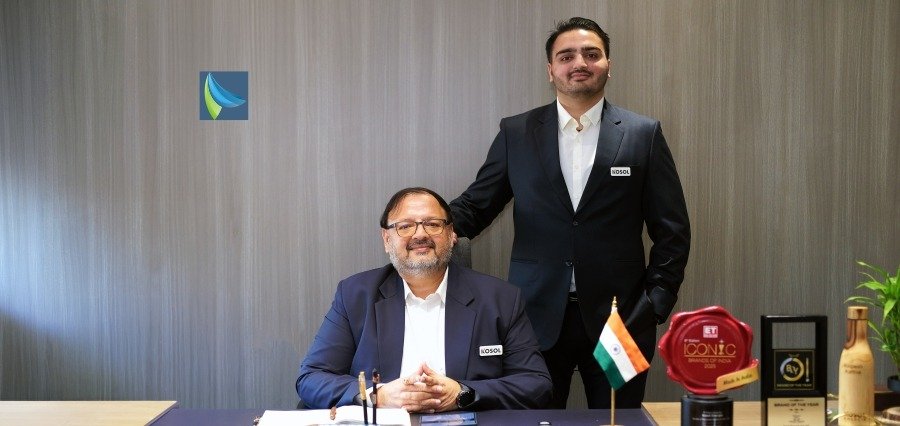
The evolution towards clean energy in India has now come at an inflection point where the addition of solar capacities, which used to dominate the renewable energy sector, is now facing limitations based on another more fundamental issue: the ability of the grid to store the energy it produces. As the need for renewable power becomes increasingly necessary in order to provide around-the-clock electricity, batteries have become the link in the chain from generation to distribution. This is a challenge that no company in the industry understands better than Kosol Energie, which specializes in providing solar and energy-related services out of Gujarat.
The journey of Kosol Energie provides a rather illuminating example. The story of Kosol Energie is not one filled with straight lines but rather of obstacles, which were turned around to form new paths for the company. The story told by Mr. Kalpesh Kalthia – Chairman & Managing Director is not one of sudden success but rather one of careful engineering, first used in solar and then storage systems.
Engineering Energy, Not Just Selling It
For Mr. Kalthia, the move into battery manufacturing was never a pivot so much as a natural extension of an identity the company has held since its earliest days. Kosol Energie has supplied battery-based solutions for off-grid systems since 2015, long before energy storage became a mainstream conversation in Indian industry circles. That early experience, he explains, gave the organization a grounded, field-tested understanding of how storage technology behaves under real operating conditions, rather than in a laboratory or on a spec sheet.
That foundation is now being scaled dramatically. Kosol Energie is establishing a state-of-the-art, fully automated battery energy storage systems facility with a planned capacity of 5 GWh, designed to serve residential, commercial, and utility-scale applications. Every stage of production, Mr. Kalthia notes, is subject to rigorous testing, from individual cells through to the finished, deployable product, a standard the company first established in its high-efficiency TOPCon solar module manufacturing line and is now replicating in storage. The intent, he says, is to apply the same uncompromising operating discipline that allowed Kosol to earn credibility in the PV module sector to an entirely new product category, rather than treating storage as a bolt-on extension of an existing solar business.
To strengthen the technological depth behind that ambition, the company acquired a strategic stake in Gridscape, a United States-based company that has deployed specialized microgrid solutions for critical infrastructure since 2015. The combination, in his view, is what will differentiate Kosol’s offering in a market that is rapidly filling with commodity suppliers.
“We are the energy engineers, not assemblers of commodity cells. By combining Gridscape’s decade of specialized American microgrid experience with our own high-volume manufacturing capability, we intend to deliver some of the most reliable energy storage solutions available in India,” he says
The Pivot That Built an Empire
To understand why Kosol Energie places such emphasis on engineering integrity, it helps to revisit the company’s origin story. Founded in 2012, the company entered the solar manufacturing space with considerable ambition, setting up a fully automated 50 MW PV module line imported from Europe and sourcing only premium raw materials. The strategy, however, collided almost immediately with a brutally cost-competitive market. For nearly two years, the company struggled to sell a meaningful volume of its modules, despite the quality embedded in every panel.
That early setback forced a defining strategic reassessment Mr. Kalthia and his team concluded that competing purely as a component supplier was not a sustainable position; the company needed to become a comprehensive solutions provider whose performance, rather than price alone, did the talking. Drawing on the decades of engineering, procurement, and construction expertise built by the Kalthia Group, which has been involved in critical infrastructure since 1960, the company redirected itself toward delivering complete, end-to-end turnkey renewable energy solutions.
The shift paid off. As clients began to experience Kosol’s operational performance firsthand and recognized the superior yields its engineering delivered, the company’s reputation strengthened, setting in motion the growth trajectory that continues today. It is a milestone Mr. Kalthia returns to often when describing the values that still govern the organization.
“That early struggle taught us the most important lesson of our existence. A product’s price might win a single order, but its performance is what builds an enduring company,” he states
Leadership That Moves with the Industry
Running a company through more than a decade of solar industry evolution has reshaped Mr. Kalthia’s own approach to leadership. In the sector’s early years, he recalls, leadership was necessarily execution-centric, focused on proving the technology worked and earning the trust of a skeptical market. Today, with the company managing far more complex engineering challenges across both solar and storage, the leadership philosophy has shifted toward what he describes as engineered agility paired with strategic foresight.
That shift shows up most visibly on Kosol’s shop floors, where engineering and manufacturing teams are given decentralised autonomy to solve problems as they arise, whether that means optimising an automated production line in real time or resolving a complex thermal management challenge in a battery energy storage system’s layout. Rigid hierarchies, in Mr. Kalthia’s assessment, are simply incompatible with the pace at which the energy storage industry now moves.
In his own words, the leader’s job in an industry evolving this quickly is not to make every decision; it is to set an uncompromising long-term horizon and then build an organization nimble enough to adapt to whatever tomorrow brings.
Turning Crisis into Catalyst
Every growing enterprise eventually meets a moment that tests its resilience, and for Kosol Energie, that moment arrived with the pandemic. The disruption brought the company’s manufacturing capabilities to a near standstill and made field execution of ongoing projects practically impossible, a situation Mr. Kalthia describes candidly as one of the most significant challenges in the company’s history.
Rather than allow the enforced pause to stall momentum, Kosol Energie made a deliberate decision to keep its workforce intact and redirect its collective energy into research and development. That period of intensive innovation produced a range of specialized products, including industrial solar dryers and advanced solar food warmers, which addressed practical needs in agriculture and food preservation at a time when conventional supply chains were under strain. The work done during this period ultimately laid the foundation for two standalone brands that continue to operate today: Sunray, a business-to-consumer brand built around bringing solar power closer to everyday households, and Koraam, a business-to-farmer brand dedicated to specialized solar farming technologies for India’s agricultural sector.
For Mr. Kalthia, the episode reinforced a broader operating principle that has stayed with the organization since. A crisis, handled correctly, is simply an unplanned invitation to innovate.
Building for Tomorrow, Today
Energy storage technology is evolving on multiple fronts simultaneously, and Kalpesh is candid that no single chemistry or component will remain dominant indefinitely. Kosol’s response, drawn directly from its experience in solar manufacturing, is to keep its infrastructure and engineering mindset deliberately future-proof. In its solar business, that meant anticipating demand for next-generation, high-efficiency technologies such as TOP Con modules rated at 650 Wp and above, including newer 730 Wp variants, well ahead of broader market adoption.
The same forward-looking philosophy now underpins Kosol’s approach to storage. Rather than tying capital to a static battery chemistry that risks obsolescence, the company is investing heavily in advanced integration and proprietary software, including intelligent Battery Management Systems and Energy Management Systems. Its architecture is designed to handle both AC- and DC-coupled utility-scale battery energy storage system configurations, ensuring that as cell-level efficiencies continue to evolve, the company’s integration platform can absorb those improvements without requiring a redesign from the ground up.
Sustainability as a Built-In Standard, not a Slogan
Sustainability conversations across the renewable energy sector often risk becoming abstractions, but Kalpesh insists Kosol Energie treats the principle as an operating requirement rather than a communications exercise. Every megawatt-peak of capacity the company deploys, he points out, directly displaces carbon-intensive generation and contributes to the broader transition toward a net-zero grid.
That commitment, however, extends beyond the company’s end products to its own manufacturing footprint. Kosol has placed considerable emphasis on the circularity of its operations, optimizing the energy efficiency of its production plants, enforcing strict waste-reduction protocols across its automated lines, and engineering its battery packs with long operational lifecycles in mind, including planning for eventual second-life grid applications or formal recycling pathways. The company’s forthcoming manufacturing facility is intended to be powered entirely by a captive, round-the-clock renewable power plant combining solar generation with Kosol’s own battery energy storage infrastructure, achieving full clean-energy self-sufficiency at the production level itself.
“If the technology you manufacture is meant to clean up the grid, the factory that builds it cannot be an exception to that standard. We are building our own self-sufficiency before we ask the market to trust ours,” he asserts
Choosing Depth Over Scale
As the battery and solar manufacturing landscape has matured, much of the industry’s attention has shifted toward hyperscaling, with manufacturers racing to build the largest possible capacities and compete primarily on price. Kosol Energie made a deliberate decision to step back from that race. Instead, the company chose to anchor its strategy around a more discerning segment of clients and asset owners, those whose primary concern is achieving the best possible Levelized Cost of Energy over a project’s full operating lifetime, rather than the lowest upfront capital outlay.
That positioning carries real trade-offs. Engineering for peak performance and longevity typically means a higher initial cost, a fact Kalpesh does not shy away from. But the underlying conviction at Kosol Energie is that clean energy infrastructure should be treated as a multi-decade asset, not a short-term commodity purchase. The company’s approach today remains anchored in premium engineering, uncompromised build quality, and superior long-term yields, with the expectation that performance data, accumulated over years of operation, will continue to validate the initial investment and reinforce client trust over time. It is, in many respects, the same lesson the company learned from its earliest struggles in 2012, applied now to an entirely different scale of decision-making: clients who understand the true lifetime cost of an asset rarely choose the cheapest option, and Kosol has built its commercial strategy around finding and serving precisely that segment of the market.
Recognition That Reflects the Work
Kosol Energie’s growth has not gone unnoticed by India’s national and global institutions. The company’s recent recognitions include the Iconic Brands of India 2025 honour from ET Edge, part of the Times Group, Best Solar Module Manufacturer of the Year 2026 by Industrial Outlook
and the Social Leadership of the Year 2025 award from the Public Relations Council of India’s Goa Chapter. On the technical side, Wood Mackenzie classified Kosol as a Grade-A Tier 1 Global Solar Manufacturer in 2025, while the Ministry of New and Renewable Energy granted national recognition for the company’s ALMM-approved manufacturing capacity expansion. The Confederation of Indian Industry also recognized Kosol Energie at the Gujarat Renewable Energy Conference 2025, and the company contributed to a Guinness World Records achievement under the Maharashtra State Electricity Distribution Company Limited in the same year.
More recently, Kosol has been listed among the Key Indian Domestic Solar Module Manufacturers and Suppliers for 2026 by JMK Research, recognized by Mercom India as the largest bidder in NREDCAP’s 1.2 GW Rooftop Solar Auction 2026, named among the Top 10 Companies Recognized for Women’s Day Excellence 2026 by Industrial Outlook, and included in Mercom India’s list of the top 150-plus module manufacturing companies for the year.
The company has also been acknowledged under the category of best state-wise solar photovoltaic manufacturing in India, a recognition that, taken alongside its other accolades, points to consistency across both technical execution and broader organizational culture. For Mr. Kalthia, these accolades matter less as trophies and more as external confirmation of standards the company holds itself to internally, regardless of who is watching. He is careful to credit the recognitions to the wider organization rather than to leadership alone, framing them as a reflection of the discipline maintained on the shop floor and in the field, not simply in the boardroom.
Counsel for the Next Generation of Energy Entrepreneurs
Asked what advice he would offer entrepreneurs entering the battery manufacturing space, Kalpesh is direct about the risk of commoditization. As the sector grows, he expects a wave of new entrants offering largely indistinguishable products built around the same off-the-shelf cells and capacity specifications. His counsel is to resist that pull toward sameness from the outset.
“Do not simply assemble standard cells and chase capacity numbers. Build a unique value proposition early, whether through proprietary technology, custom software, or a genuinely different business model, because the companies that survive a crowded market are the ones that cannot be easily replicated,” he declares
He points to emerging models such as Energy-as-a-Service, tailored to specialized client niches, as one example of the kind of differentiation that can insulate a young company from the commodity race that consumed much of the broader industry’s margins. For Kalpesh, the lesson is consistent with Kosol’s own founding story: differentiation, not scale alone, is what determines which companies endure.
The Road to KoBESS and 2030
Looking toward the rest of the decade, Kalpesh’s ambitions extend well beyond Kosol Energie’s current manufacturing footprint. The company’s long-term vision is anchored in KoBESS, its specialized energy storage subsidiary, which he intends to position as a global benchmark for integrated clean energy storage ecosystems by 2030. The framing is deliberate: Kosol does not see itself as a manufacturer operating in isolation, but as a primary enabler of grid decarbonization at scale.
As renewable energy continues its trajectory toward becoming the dominant source of baseline power globally, he argues that storage will inevitably become the backbone of grid stability, the mechanism that makes intermittent green generation reliably dispatchable around the clock. Through KoBESS, Kosol intends to deploy intelligent, gigawatt-scale storage solutions while continuing to bridge international technological innovation with scaled, world-class domestic manufacturing.
The chairman emphasizes “Energy storage is not a side business for us; it is the infrastructure that will determine whether the renewable transition actually works. Our role through KoBESS is to make sure that when the grid needs clean power at three in the morning, it is there, dispatchable, and dependable.”
It is a fitting closing thought for a company whose journey, from a struggling 50 MW module line in 2012 to a planned 5 GWh storage facility today, has consistently been defined by the willingness to rebuild itself around performance rather than convenience. As India’s energy storage industry enters its most consequential decade, Kosol Energie bets that engineering depth, not manufacturing scale alone, will be what shapes the companies that define 2030 and beyond. For Insights Success India, and for an industry watching closely to see which manufacturers will still matter once the current wave of capacity expansion settles, his answer is unambiguous: the companies that survive will be the ones that engineered for the long run from the very beginning.