
Have you ever thought of someone you had not spoken to in months, only for them to call you minutes later? Or sat with a close friend in complete silence, both somehow knowing exactly what the other was feeling without a single word passing between you? These moments feel extraordinary. They also feel oddly familiar. Most people have experienced something like this at least once, and most have quietly wondered what to make of it.
That wondering has a name. It has a history stretching back thousands of years. Today, scientists and neuroscientists are working to understand whether something genuinely real lies behind it. The question of what is the definition of telepathy has moved from philosophy and folklore into some of the most advanced research happening in the world right now.
This blog discusses what is the definition of telepathy, where the idea comes from, what science has found, and how modern technology is beginning to create something that looks remarkably like it.
What Is the Definition of Telepathy
The word comes from two Greek roots. Tele means distant. Pathos means feeling or perception. Together, telepathy describes the experience of feeling or perceiving across a distance, without any physical means of communication.
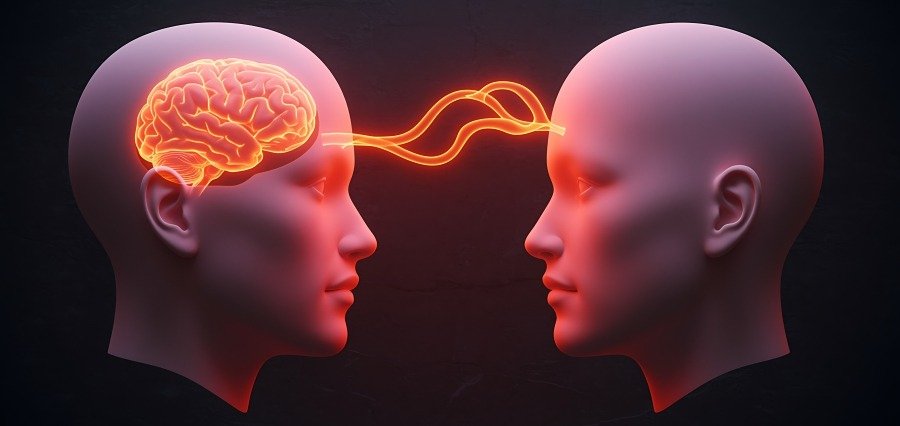
The most widely accepted explanation describes it as the direct transmission of thoughts, feelings, or information from one mind to another, without using the five known senses or any known physical channel. No words. No gestures. No signals. Just thought moving between two people.
What is the definition of telepathy in practical terms? This is the notion that the human mind is capable of transmitting and receiving information beyond the limits of the physical body. How that happens is exactly what researchers and thinkers continue to debate.
A History Older Than the Word
Long before anyone formally asked what is the definition of telepathy, the experience it describes was already woven deeply into human culture across the world.
Ancient Indian philosophy addressed it directly. In Jaina philosophy, the Manah-paryaya notion refers to the capacity for some evolved souls to understand the minds of other beings. The Vedas mention how the seers were able to communicate over large distances using their mental concentration. Yogic philosophy holds that the mind can project awareness well beyond the body.
Across other cultures, the pattern repeats. Indigenous traditions worldwide, Sufi mysticism, and ancient Greek philosophy all contain descriptions of mind-to-mind awareness that align closely with what we now call telepathic connection. That it appeared independently across civilisations with no contact is worth noting.
What Science Actually Found
The formal scientific investigation of what is the definition of telepathy began seriously in the late nineteenth century. The Society for Psychical Research collected thousands of case reports and ran controlled laboratory studies, including the Ganzfeld experiments, where one person attempts to transmit an image mentally to another in a sensory-reduced environment.
The results have been genuinely mixed. Some studies reported hit rates slightly above chance. Others, when independently replicated under stricter conditions, did not hold up. The mainstream scientific consensus remains that no reliable, reproducible evidence for telepathy as a paranormal phenomenon has been established.
What science has confirmed, however, is something equally remarkable. The human brain produces measurable electrical signals. Those signals can be read, decoded, and transmitted. That discovery opened an entirely new line of enquiry, one that takes what is the definition of telepathy and begins rebuilding it from the ground up using neuroscience and engineering.
Brain Wave Communication: Where Science Meets the Idea
Brain wave communication refers to the use of technology to read electrical signals from the brain and transmit them to another device or another person. It requires no paranormal explanation. It operates entirely within the known laws of physics and biology.
Research teams have already demonstrated that one person’s brain signals can guide another person’s hand movements through a direct brain-to-brain interface. Paralysed patients have communicated full words and sentences simply by thinking them, with devices converting neural activity into readable text. Advanced brain-computer interface technology being developed by research institutions and private companies is pushing these capabilities further every year.
Brain wave communication is not telepathy in the traditional sense. It requires hardware, signal processing, and significant technical infrastructure. But it is creating a measurable, repeatable version of something humans have described instinctively for centuries. The gap between the ancient idea and the modern laboratory is narrowing in ways that were unimaginable even a generation ago.
What is the definition of telepathy beginning to look like through this lens? It is starting to look less like a mystery and more like a technology problem that humanity is slowly solving.
The Telepathic Connection We Already Experience
Science aside, the experience of telepathic connection is genuinely real to the people who live it. Twins who report sensing each other’s distress across long distances. Parents who wake at the exact moment a child is in danger miles away. Long-term partners who reach for the phone to call each other at precisely the same moment.
These experiences resist easy dismissal. Research into close human relationships shows that deep familiarity creates something that functions like extraordinary mutual understanding. People who know each other deeply develop such sensitivity to each other’s rhythms that words become almost unnecessary. Whether this qualifies as telepathy scientifically is debated. That it feels real to those who experience it is not.
India, with its long tradition of valuing inner awareness, intuitive knowledge, and the bonds between individuals, has always held space for this kind of experience without demanding a laboratory explanation for it. The telepathic connection between guru and student, or between family members separated by distance, is recognised in Indian culture as a genuine expression of human closeness that other traditions are only beginning to acknowledge.
What Comes Next
Brain wave communication has moved from basic signal detection to actual two-way brain-to-brain communication in laboratory settings. As the field advances, its potential uses will multiply.
For medical purposes, Brain Wave Communication holds incredible promise for those who have lost the ability to speak or move. For education, it raises questions about how knowledge and skill might one day be transferred directly. For human connection, it raises the possibility of sharing felt experience directly
None of this is simple. The ethical questions around consent, privacy, and access are serious and deserve careful thought. But the direction of travel is clear.
Conclusion: A Question That Refuses to Stay Still
What is the definition of telepathy has never had a fully settled answer, and that is part of what makes it so enduringly compelling. As brain wave communication technology advances, the boundary between the scientifically possible and the historically mystical is shifting.
The ancient Indian philosophers, the neuroscientists running brain interface experiments today, and the ordinary person who thought of a friend just before they called are all circling the same question. The telepathic connection humans have always sensed between themselves may turn out to have a scientific explanation after all. Whether that makes it more or less remarkable is entirely a matter of perspective.