
The world is running short on clean water, and the gap between demand and supply is widening faster. Urbanisation is accelerating, groundwater tables are falling, and the infrastructure built to manage wastewater in many parts of the world was designed for a different era entirely.
Wastewater treatment, for all its technical progress, has remained largely unchanged in its core logic: energy-heavy, maintenance-dependent, and built around centralised systems that were never really designed with long-term sustainability in mind. That gap between what exists and what the moment demands has quietly become one of the more pressing challenges in environmental infrastructure today.
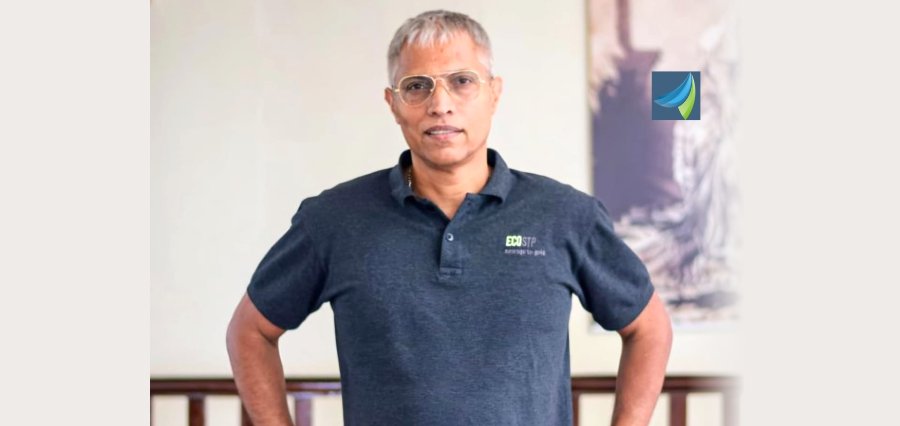
Tharun Kumar, Founder & CEO of ECOSTP Technologies, has spent years working on exactly that gap and building toward something different. His path into sustainability was far from conventional, but it is precisely the breadth of experience he brought into the field that gives his perspective its distinctiveness. At ECOSTP Technologies, he has driven a leadership approach that treats wastewater not as a disposal problem but as an opportunity to work with natural processes rather than against them.
Let’s explore the ideas shaping Tharun’s approach to sustainable infrastructure!
A Career Built Across Multiple Disciplines
What distinguishes Tharun’s professional journey is the breadth of experience that shaped it. Before becoming associated with sustainability and wastewater innovation, he spent years working across technology, information security, governance, and enterprise operations with organisations including Motorola, Hughes, Cable & Wireless, and Aujas Networks.
That early exposure to large-scale systems management became an important influence on his later work. Managing complex operational environments taught him that most large problems are rarely isolated. They are interconnected systems challenges requiring adaptability, long-term thinking, and cross-functional understanding.
His role in leading large information security and governance initiatives, including projects connected to India’s Aadhaar ecosystem, reinforced the importance of operational reliability and structured execution, qualities that would later become central to his environmental work as well.
The transition towards sustainability emerged gradually through his growing involvement in environmental consulting and wastewater advisory projects. Working closely with industries and infrastructure systems exposed him to recurring inefficiencies within conventional sewage treatment models, including high power consumption, operational complexity, expensive maintenance cycles, and long-term sustainability concerns.
Rather than seeing those limitations as fixed realities, he began exploring whether natural ecosystems already offered more efficient alternatives. That line of thinking eventually evolved into a biomimicry-led approach that would define much of his leadership journey.
Reimagining Wastewater Through Biomimicry
At the centre of Tharun’s work is a belief that nature often solves problems with a level of efficiency modern systems struggle to replicate. This philosophy became the foundation for his exploration into biomimicry-driven wastewater treatment.
Inspired by the biological ecosystem inside a cow’s stomach, the treatment approach developed under his leadership focuses on enabling naturally occurring microorganisms and ecological processes to perform the work traditionally dependent on mechanical systems and chemical intervention. At the heart of this approach is a larger vision that continues to guide his work: “Our moonshot mission is to reclaim every drop of wastewater, naturally.”
The idea challenged many accepted assumptions within the wastewater sector. Conventional treatment infrastructure has long relied on continuous aeration, power-intensive equipment, and operational oversight to maintain treatment quality. Proposing a decentralised, low-energy alternative naturally invited scepticism in an industry conditioned to equate complexity with effectiveness.
Yet over time, measurable outcomes began validating the approach. The systems developed under his leadership have now contributed to reclaiming billions of litres of wastewater into reusable water while expanding across multiple regions in India and neighbouring countries. The work has also received recognition from organisations including the World Economic Forum’s UpLink platform, the American Chemical Society, and the United Nations sustainability ecosystem.
More importantly, the work has contributed to changing conversations around wastewater itself. Rather than treating sewage solely as waste requiring disposal, the approach reframes it as a recoverable resource within a circular environmental system.
That shift in perspective reflects a larger theme throughout his leadership. Sustainable innovation is often less about inventing entirely new realities and more about redesigning existing systems to work in harmony with natural processes.
Leadership Through Curiosity and Systems Thinking
One of the defining characteristics of Tharun’s leadership style is his emphasis on curiosity-driven problem-solving. His perspective on sustainability extends beyond technical conversations, often drawing connections between ecology, human behaviour, design, and the long-term relationship between infrastructure and the natural world.
That interdisciplinary mindset has shaped both the direction of his work and the culture around it. Sustainability, in his approach, is not confined to compliance frameworks or environmental branding. It is treated as a continuous process of experimentation, learning, and adaptation.
This becomes especially visible in the way he approaches emerging environmental concerns. Whether exploring natural pathways for heavy metal removal from treated wastewater or participating in conversations around “One Health” frameworks connecting human, environmental, and ecosystem wellbeing, his focus consistently remains on understanding interconnected systems rather than isolated technical outcomes.
At the same time, his leadership remains strongly execution-oriented. Environmental innovation often struggles when ideas fail to translate into operational reliability. Much of his work has therefore centred on bridging the gap between sustainability ambition and practical implementation.
Expanding Impact Beyond Environmental Technology
Although wastewater innovation remains central to his professional identity, Tharun’s broader work reflects a wider commitment to social transformation and human development.
For more than a decade, he has also led LifeDream Foundation, a nonprofit initiative focused on supporting school dropouts through entrepreneurship training, life-skills development, digital education, and employability programmes. The initiative has helped individuals from underserved backgrounds build livelihoods and transition towards economic independence.
The connection between this work and his environmental leadership is more significant than it may initially appear. Both are rooted in the same underlying philosophy. Sustainable progress requires systems that empower people rather than exclude them.
That perspective also extends into organisational culture. As his teams have expanded, increasing emphasis has been placed on building inclusive workplace practices, collaborative learning environments, and long-term institutional frameworks capable of supporting sustainable growth.
In many ways, this reflects a broader evolution in modern leadership itself. Technical capability alone is no longer sufficient for building lasting impact. Leaders today are increasingly expected to combine innovation with social awareness, institutional responsibility, and ecosystem thinking.
Contributing to a Larger Environmental Shift
Over the last several years, Tharun has become an increasingly active participant in national and international sustainability discussions focused on water management, climate resilience, and regenerative infrastructure.
From industry forums and deep-tech platforms to academic collaborations and environmental conferences, his work consistently emphasises the need to move beyond resource-intensive infrastructure models towards systems that are decentralised, regenerative, and ecologically aligned.
This vision has become particularly relevant as global conversations around water security intensify. Rapid urbanisation, groundwater depletion, climate volatility, and rising infrastructure costs are forcing governments and industries to reconsider how wastewater is treated, reused, and reintegrated into environmental systems.
The larger significance of his work extends beyond any single technology platform. It represents part of a growing movement towards infrastructure models that prioritise resilience, circularity, and long-term ecological balance over short-term operational convenience.
Shaping the Future of Sustainable Systems
The future of sustainability leadership will likely depend on the ability to rethink systems that societies have long taken for granted. Water infrastructure, waste management, energy consumption, and urban planning are all entering a period of transformation where efficiency alone will no longer be enough. Regeneration, adaptability, and ecological compatibility are becoming equally important.
Tharun’s work reflects this transition clearly. By combining systems thinking, biomimicry, deep-tech experimentation, and social purpose, he has helped expand how wastewater treatment is understood, not simply as an engineering requirement, but as part of a larger environmental and societal ecosystem.
His leadership journey also demonstrates that meaningful innovation often emerges from challenging assumptions that industries have accepted for decades. In a field traditionally dominated by mechanical intensity and centralised infrastructure, he has continued advocating for approaches inspired by nature’s own ability to recycle, regenerate, and sustain balance.
Through his continued focus on regenerative systems and nature-led thinking, Tharun Kumar represents a growing generation of leaders working to build infrastructure models that are not only functional but also environmentally resilient and socially relevant for the future.