
The clean energy transition generates a problem that most conversations about sustainability quietly skip over. Batteries power electric vehicles, store renewable energy, and reduce dependence on fossil fuels. But every battery eventually ages, loses capacity, and reaches the end of its first application. What happens next is where the environmental promise of the energy transition either holds or starts to unravel. Sending usable batteries straight to recycling wastes resources. Reusing them without proper assessment creates safety risks. The responsible path runs through something more disciplined and more technically demanding than either shortcut.
The companies addressing this challenge are not simply recyclers or traders. They are building new infrastructure for a circular battery economy that does not yet fully exist.
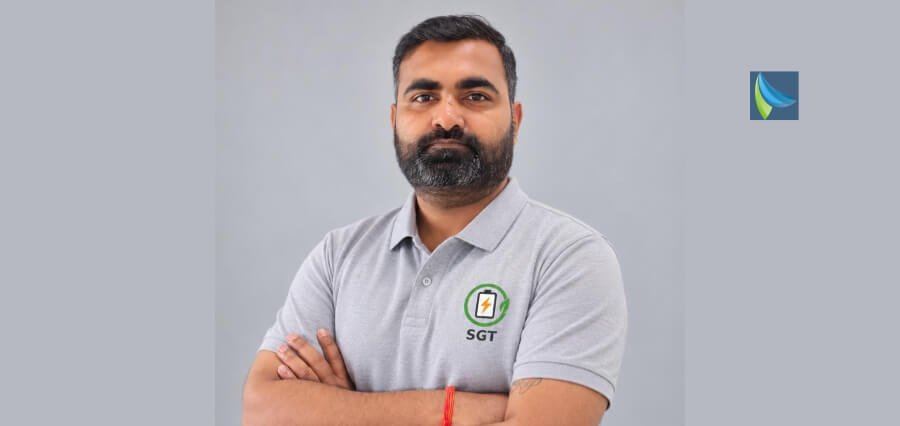
Samsara Greentech Private Limited, led by Ankit Shahi as Founder and CEO, is building exactly that infrastructure. Starting from the observation that a retired battery pack often still contains significant usable capacity, the company has developed a rigorous approach to testing, grading, repurposing, and ultimately recycling lithium-ion batteries in a way that extracts maximum responsible value at every stage.
A Different Perspective on Battery Life
Samsara Greentech Pvt Ltd began with a simple observation: “The end of a battery’s first application does not necessarily mean the end of the useful life of every cell inside it.” Retired battery packs can still contain significant usable capacity, but unlocking that value requires proper testing, segregation, and an understanding of the cell’s remaining performance.
The company saw both an environmental challenge and a business opportunity in this gap. Instead of treating every retired battery immediately as scrap, it wanted to determine what could be responsibly reused, what could be repurposed, and what genuinely needed to move into recycling.
Its initial journey focused on sourcing used lithium-ion batteries, dismantling them, testing cells, and creating a reliable second-life supply chain. As its understanding of cells, chemistries, and applications developed, its vision expanded. It now sees itself evolving from a battery repurposing business into a broader circular-energy company, with testing and diagnostics, second-life applications, battery-pack assembly, and energy-storage solutions forming different parts of the same ecosystem.
The company’s long-term objective is straightforward: extract the maximum responsible value from a battery throughout its useful life and ensure that recycling becomes the final stage of the journey rather than automatically the first destination.
Making Safety the Foundation
For Samsara Greentech, extending battery life cannot come at the cost of safety. “A used cell is not selected simply because it can still hold a charge. Its condition and behaviour must demonstrate that it is suitable for the next application.”
The company’s approach starts with dismantling and individual cell assessment. It evaluates parameters such as voltage, capacity, internal resistance, State of Health, and State of Charge. These results are then used to segregate and grade cells. Cells showing abnormal behaviour, physical damage, or unsuitable performance characteristics are excluded from reuse and directed toward the appropriate recycling channel.
An equally important principle is matching the battery to the application. A cell that is no longer suitable for a demanding mobility application may still have potential for a less demanding stationary application, provided it meets the required safety and performance criteria.
As Samsara Greentech develops second-life energy-storage solutions, it intends to build additional layers of protection through appropriate BMS architecture, thermal management, electrical protection, traceability, and continuous performance monitoring.
The company’s philosophy is that “second-life storage has to earn customer confidence through data and engineering rather than simply through a lower price.”
Building a Team Around Innovation
Samsara Greentech’s leadership philosophy is built around ownership, technical curiosity, and disciplined execution. The battery industry is evolving quickly, and the company believes it cannot operate with a rigid mindset. It wants people who are willing to question assumptions, learn from actual battery behaviour, and take responsibility for solving problems.
The company also believes “Innovation should be practical. Technology has value when it improves safety, reliability, efficiency, or economics for the customer.” This is particularly important in second-life batteries, where every incoming battery can have a different history.
As it builds its team, it wants to combine people with hands-on battery experience with talent in electronics, BMS, data analytics, software, and energy systems. Creating this combination of practical engineering and data-driven decision-making will be important for the company’s next phase.
This approach allows technical understanding and practical problem-solving to remain connected. Rather than treating innovation as an idea alone, the company focuses on how technology can address actual battery behaviour and customer requirements.
From Conventional Trading to Battery Products
One of Samsara Greentech’s important milestones has been moving beyond conventional trading and developing an in-house capability to dismantle, test, grade, and understand used lithium-ion cells.
This capability gave the company direct insight into how batteries age and how much variation can exist even among cells originating from the same pack. Understanding these differences has strengthened the importance of testing and grading within its second-life approach.
A second milestone has been expanding from second-life cell trading toward battery-pack assembly and developing its own battery products. This transition has helped the company understand both sides of the value chain, from the behaviour of an individual cell to the requirements of a complete battery system.
Commercial growth has also provided important validation. Building the business while simultaneously investing in technical capability has demonstrated that circular battery solutions can have both environmental relevance and commercial potential.
Perhaps the most important milestone, however, has been the evolution of the company’s ambition. Samsara Greentech started by asking how usable cells could be recovered from discarded batteries. It is now asking how technology, diagnostics, and energy-storage engineering can help manage the entire second life of a battery.
Making Battery Decisions More Data-Driven
Samsara Greentech believes the next major advancement in battery repurposing will come from improving the quality of decisions made about each battery.
Today, the company’s foundation is physical testing and diagnostics. It assesses capacity, internal resistance, voltage behaviour, State of Health, and other performance indicators before deciding whether and where a cell should be reused.
Its technology roadmap is to make this process increasingly data-driven. As the volume of batteries processed grows, the resulting test and performance data can help the company build better models for grading cells, matching similar cells during reassembly, identifying abnormal behaviour, and estimating remaining useful life.
Machine learning and real-time monitoring are therefore capabilities that Samsara Greentech sees as important to progressively develop rather than simply labels to attach to a product.
The company ultimately wants the history and behaviour of a battery to become measurable information that supports decisions throughout its second life. This can help create a stronger connection between physical battery assessment, data, reassembly, and ongoing system performance.
Addressing the Challenge of Inconsistency
The biggest technical challenge in second-life batteries is inconsistency. Unlike manufacturing with new cells of identical specifications and production batches, used batteries arrive with different ages, usage patterns, temperatures, charging histories, and degradation levels.
This makes testing and segregation critical, while also affecting operating cost and scalability. Samsara Greentech has responded by focusing on stronger testing procedures, cell-level grading, and matching cells with applications appropriate to their remaining performance.
Another challenge is perception. Customers naturally ask whether a second-life battery can be dependable. The company believes the answer should come from transparent performance data, appropriate warranties, protection systems, and demonstrated field performance rather than marketing claims.
Supply-chain consistency and the development of standards for second-life batteries are additional industry-wide challenges. Samsara Greentech’s approach is to grow in a controlled manner, improve processes through experience, and avoid compromising technical discipline simply to increase volumes.
This approach reflects the company’s broader belief that technical understanding must come before scale. In a sector where differences between used batteries can affect safety, performance, and operating costs, careful processes remain central to responsible growth.
Creating Value Through Circular Battery Solutions
For a young company, Samsara Greentech believes “The strongest validation is not necessarily an award or headline. It is whether the market repeatedly finds value in what the company is building.”
For the comapny, an important validation has been its ability to develop a commercial business around used lithium-ion batteries while progressively building capabilities in testing, grading, and battery assembly.
This demonstrates that extending battery life can create economic value alongside environmental benefits. The company is also developing relationships across the battery value chain with suppliers, customers, recyclers, and technology partners.
These relationships help Samsara Greentech understand where second-life batteries genuinely make technical and commercial sense. They also contribute to the company’s understanding of the wider battery ecosystem and the requirements of different participants within it.
The company prefers to treat recognition as an outcome rather than an objective. Its priority is to build credible technology, reliable products, and measurable results. It believes stronger industry partnerships and recognition will follow from that foundation.
Developing Storage for Different Applications
Stationary energy storage represents an important opportunity for second-life batteries because operating requirements can be very different from those of an electric vehicle.
Samsara Greentech’s approach is to develop solutions around the actual requirements of an application rather than forcing one battery architecture into every use case.
Commercial and industrial customers may require peak-load management, backup power, or energy-cost optimization. Renewable-energy projects may require storage to manage the intermittency of solar generation. These different requirements make application-specific solutions important.
As the company expands in this area, its focus will be on modular system design, stronger BMS and monitoring capabilities, application-specific cell selection, and solutions that can scale according to customer requirements.
The economic proposition is equally important. If second-life batteries can provide dependable storage at an attractive lifecycle cost while extending the productive life of existing resources, they can make energy storage accessible to a broader segment of the market.
For Samsara Greentech, this connects the environmental purpose of battery repurposing with the practical requirements of energy storage. The value of a second-life battery therefore depends on whether it can deliver dependable performance while making effective use of an existing resource.
Making Sustainability Part of the Business
Samsara Greentech’s approach to sustainability is closely connected to its view of business economics. Sustainability works best when it is built into the economics of a product rather than treated as a separate initiative.
For a clean-energy company, the starting point is solving a genuine customer problem. A product must be safe, reliable, and commercially competitive. Environmental impact can then scale as customers adopt the solution for practical reasons while also gaining sustainability benefits.
This philosophy also shapes the company’s approach to growth. Samsara Greentech does not want to pursue scale before understanding the technology deeply. In battery systems, small technical assumptions can become safety or performance issues when they are repeated across thousands of cells.
The company therefore places importance on building processes first, collecting real-world data, understanding failure modes, and being transparent about capabilities and limits. This creates a foundation for sustainable growth and reduces the risk of scaling a process that later requires major correction.
For Samsara Greentech, sustainable growth is therefore not simply about expanding quickly. It is about developing technical understanding and operational discipline that can support growth over time.
Building an Integrated Circular-Battery Future
Looking toward the coming years, Samsara Greentech’s ambition is to build an integrated circular-battery and energy-storage company.
The first priority is to strengthen its core capabilities in battery testing, diagnostics, grading, and repurposing. From there, the company intends to expand its battery-pack capabilities and progressively develop modular second-life energy-storage solutions for stationary, commercial, industrial, and renewable-energy applications.
Technology will play an increasingly important role in this journey. Samsara Greentech wants to build stronger battery intelligence around traceability, State-of-Health assessment, remaining-life estimation, cell matching, and real-time system monitoring.
The aim is to make second-life batteries more predictable and bankable assets. Better information about a battery’s history, condition, remaining life, and behaviour can support decisions across its second-life journey.
Over the longer term, it wants to participate in a truly circular battery ecosystem in which batteries are manufactured, used, evaluated, repurposed, and ultimately recycled with greater efficiency.
The company’s aspiration is not simply to sell more batteries. It is to help change how the industry defines the life of a battery. By extending the productive life of existing resources, reducing premature waste, and making dependable energy storage more affordable, it aims to create both commercial value and meaningful environmental impact.
Its journey is therefore built around a clear principle: “A battery’s first application does not necessarily define the full value it can provide.” Through testing, diagnostics, responsible repurposing, battery-pack assembly, and energy-storage solutions, it is working toward a model in which more value can be extracted from existing battery resources before they reach their final stage.
As the company continues developing its capabilities, its focus remains on combining technical understanding with practical applications, using data to improve decisions, and building solutions that connect commercial value with environmental responsibility. This approach forms the foundation of Samsara Greentech’s vision for the future of batteries and clean energy storage.