
A Safer Ride Upward
Daily, about 20,000 individuals per unit per annum move within office blocks, hospital buildings, apartment buildings, and shopping centers through elevators globally. People simply walk into these elevators without batting an eye. The assurance, silent and automatic, and largely subconscious, is dependent totally on the performance of the elevator safety solutions offered by the industry behind the scenes. In case these solutions malfunction, the implications go well beyond mere mechanical breakage.
The facts paint a grim picture indeed. According to reports from the U.S. Bureau of Labour Statistics and the Consumer Product Safety Commission, there are about 900 elevator accidents involving injuries every year worldwide. Mechanical problems cause about 15.3 percent of such accidents, while door malfunctions and mis-levelling at floors constitute one of the commonest causes of injury. Importantly, estimates indicate that 50 percent of all elevator deaths can be prevented. This means that the industry does not have an impossible problem.
The Stakes Keep Rising
Global market for elevators and escalators is expanding at a very fast pace. The market for elevator services is expected to be at $94.6 billion USD by 2024. The market for elevator modernization alone is forecasted to reach $12.3 billion USD by 2025. With more cities growing and construction of high-rise buildings rising in pace, number of elevators in use keeps on growing, and so should Elevator Safety Solutions.
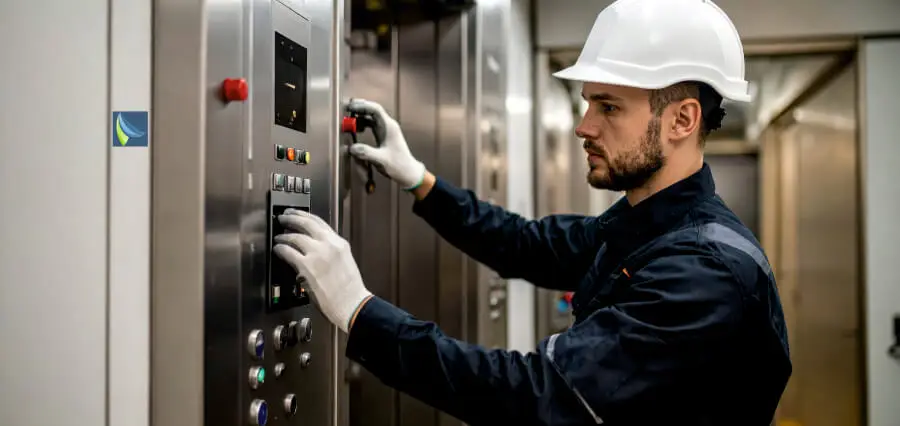
The human aspect increases the pressure. More than half of the fatalities and injuries related to elevators take place among the installation and maintenance personnel. Elevator installers are one of the occupations with the sixth-highest death rate at workplace in the construction industry, with fall into the shaft being the most common cause of fatality. Passengers are protected only after the work is done, but their safety starts much earlier.
A Real-World Programme That Set a Standard
The context for India’s elevator safety regime is both extensive and urgent. The Bureau of Indian Standards (BIS) regulates the safety of elevators via IS 14665, the national standard on the installation, testing, and maintenance of electric traction lifts. DGFASLI ensures compliance with the above-mentioned regulations at places of work subject to the provisions of the Factories Act, 1948. In Maharashtra, the Lifts, Escalators and Moving Walks Act, 2017 one of the most exhaustive elevator regulations in India makes it mandatory for all lifts running in the state to undergo periodic inspection and get a third-party certification in light of rising incidents of entrapment and malfunctions in older buildings in Mumbai. The act obligates building owners to acquire a fitness certificate after each inspection and also restricts maintenance operations solely to licensed competent persons. It provides a legislative example of how state governments can implement safety measures within elevators.
What Robust Solutions Look Like
Current Elevator Safety Strategies involve technological innovations along with regulations and maintenance practices working together. With the use of IoT sensors, modern technologies can decrease the number of equipment failures by 50 percent from 2015 to 2025, which is what statistics shows. Predictive maintenance, which is implemented by using artificial intelligence, has managed to decrease the number of incidents by 25 percent. Automated safety reminders to the maintenance crew have led to a decrease of the accidents’ frequency by 18 percent. All the numbers show that there is a structural change in the way how the industry approaches risk management before it happens.
Regulations play an important role in this process as well. ASME A17.1 Safety Code for Elevators and Escalators is the most commonly used code in North America, and code changes since 2016 have managed to decrease the risk level by 40 percent in jurisdictions that follow them. Buildings that do not conform to this regulation are at risk of liability and fines.
Trust Is Built Through Process, Not Assumption
Elevator safety is trusted automatically by the public. This trust cannot be established once upon installation but must be continually reinforced with each inspection and maintenance cycle, upgrade in software, or training for technicians. Those elevator safety solutions based on assumption, rather than process, create the very risks that make the news and ruin careers.
Organizations that choose to implement predictive maintenance, inspections according to schedule, and qualified third-party verification not only prevent accidents but establish the organizational integrity required in our time. Amidst the rapid growth of a market driven by urbanization, the organizations that take safety seriously will determine the standards of reliability in the decades to come.
The soft hum of an elevator moving carries within it much effort and careful planning. Elevator safety solutions are there to ensure nothing gets broken along the way.